When you invest thousands of pounds in new double glazing, the last thing you want is a legal headache when you come to sell your home. Yet every year, thousands of UK homeowners discover – mid-conveyancing – that their window installer never registered the work. No certificate. No compliance record. Just a costly scramble to put things right.
Understanding FENSA and Certass certification isn’t just paperwork admin. It’s the difference between a smooth property sale and an unexpected bill of £200–£500 for a retrospective Building Regulations certificate – or worse, a sale that falls through entirely.
One industry estimate suggests 94% of homeowners hire professional installers for glazing work, making the question of certification more relevant than ever. This guide gives you everything you need to know – in one place.
Why Building Regulations Compliance Is a Legal Requirement, Not an Optional Extra
Under Building Regulations Part L (which governs the conservation of fuel and power), any replacement window or external door installed in England and Wales must comply with minimum thermal performance standards. These rules exist to reduce energy consumption across the UK’s housing stock – a key pillar of the government’s Future Homes Standard agenda.
Compliance must be formally registered with your local council. Before 2002, this meant paying for an independent building control inspection every time you had windows replaced – a slow, bureaucratic, and expensive process. The introduction of competent person schemes changed everything.
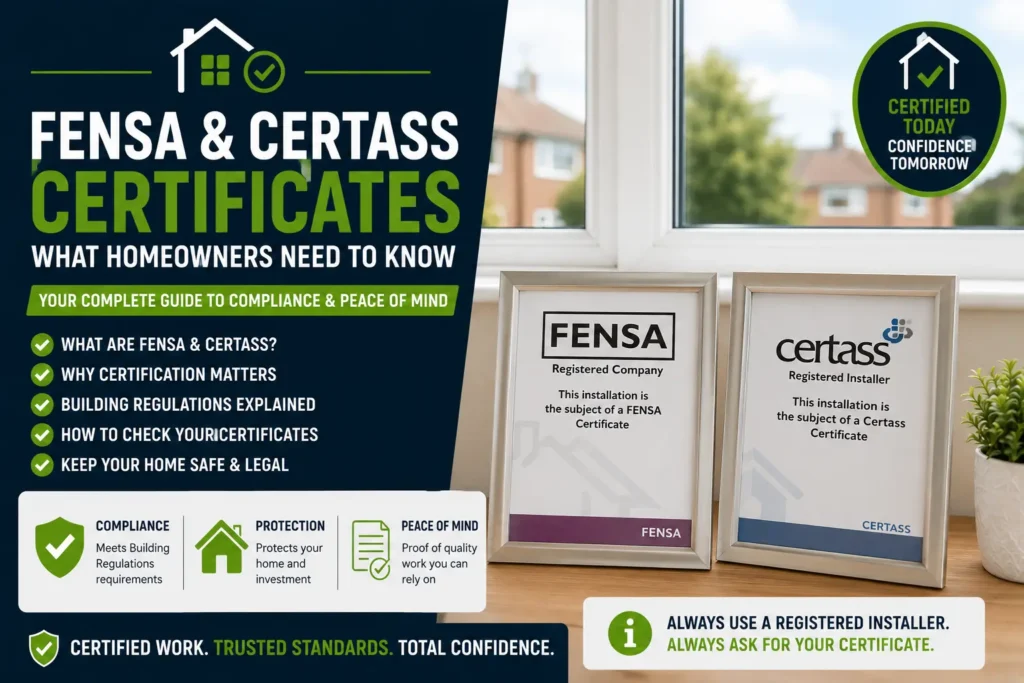
FENSA (Fenestration Self-Assessment Scheme) and Certass are both government-authorised competent person schemes – and using a registered installer from either is the most common way homeowners demonstrate compliance. The alternative is to apply directly to your local authority for building control approval, which involves inspections and fees. When a registered installer fits your windows, they self-certify that the work meets Building Regulations and notify your local council on your behalf. You receive a certificate as evidence of that compliance. The system works quietly in the background – unless your installer isn’t registered with any approved scheme.
FENSA and Certass: Origins, Scale, and Scope
FENSA – The Industry Standard Since 2002
FENSA was established in 2002 by the Glass and Glazing Federation (GGF) in response to the tightening of Building Regulations around thermal performance. Its singular focus is replacement windows and external doors – it does not cover new-build glazing or other home improvements.
Today, FENSA has over 14,000 registered companies across the UK, from large national brands to sole-trader installers. It is the most widely recognised certification scheme in the domestic glazing sector, and the name most solicitors and conveyancers look for during property transactions.
Key facts about FENSA:
- Work should be registered promptly; if you do not receive your certificate within 30 days, contact FENSA directly
- Every installation is automatically registered with the local council
- Registered installers are expected to provide appropriate insurance-backed guarantees where required
- Members are subject to regular audits to maintain standards
- FENSA is a GGF Group Company, giving it deep industry roots
Certass – Broader Coverage, Deeper Roots
Certass has operated as a government-authorised competent person scheme since 2006. Where FENSA is narrowly focused on glazing, Certass operates across a wider spectrum of building improvements including windows, doors, conservatories, loft conversions, and energy-efficiency measures.
Certass holds UKAS accreditation (the national accreditation body for the UK) and is a registered member of TrustMark – the government-endorsed quality scheme for tradespeople. This dual accreditation gives it strong credentials, particularly for homeowners undertaking multiple improvement projects simultaneously.
Certass also has a direct connection to the Green Deal framework, making it a relevant certification body for homeowners seeking energy-saving finance options. The Energy Saving Trust recognises Certass-certified installations as meeting the energy efficiency standards required for upgrade incentives.
FENSA vs Certass: A Side-by-Side Comparison
| Feature | FENSA | Certass |
|---|---|---|
| Established | 2002 | Govt-authorised since 2006 |
| Scope | Windows & doors only | Windows, doors, conservatories, extensions, loft conversions |
| Registered installers | 14,000+ | Growing national network |
| UKAS accredited | No | Yes |
| TrustMark member | Via GGF | Direct membership |
| Green Deal connection | Limited | Yes |
| Certificate follow-up | Contact scheme if not received within 30 days | Contact scheme if not received within 30 days |
| Local council notification | Automatic | Automatic |
| Inspection approach | Self-certification with audits | Self-certification + optional surveyor inspections |
| Best suited to | Standard glazing replacements | Multi-improvement projects |
Consumer Protection: What Each Scheme Actually Guarantees
Both FENSA and Certass provide more than a piece of paper – they underpin a framework of consumer protection that most homeowners never need to use, but are glad exists when they do.
Under FENSA, registered installers are expected to provide appropriate insurance-backed guarantees where required, helping protect homeowners if an installer ceases trading.
Under Certass, a similar insurance-backed guarantee applies, with the added benefit of UKAS oversight – meaning Certass itself is independently audited for the quality of its certification process, not just the installers it registers.
Both schemes require members to adhere to their codes of conduct, and both offer dispute resolution processes if you’re unhappy with an installation. Neither scheme, however, replaces the need to use a reputable installer – certification is a baseline standard, not a substitute for due diligence. Before you sign anything, work through our double glazing buying checklist to make sure you’re covered.
TrustMark and Energy-Efficiency Scheme Relevance
If you’ve come across TrustMark during your research, it’s worth understanding how it sits alongside FENSA and Certass rather than competing with them.
TrustMark is a government-endorsed scheme that approves tradespeople across a huge range of home improvement sectors – it’s the overarching quality mark, whereas FENSA and Certass are the specific technical certification bodies for Building Regulations compliance.
Certass’s direct TrustMark membership means that Certass-registered installers automatically carry an additional layer of consumer protection through TrustMark’s dispute resolution framework. FENSA installers can also obtain TrustMark status, but it isn’t automatic – it requires a separate application via the GGF.
For homeowners exploring energy-efficiency upgrades and any associated funding or finance schemes, Certass’s energy-efficiency accreditation gives it broader relevance than FENSA’s glazing-only remit. If you’re looking at government-backed or lender-linked improvement programmes, it’s worth checking the eligibility requirements of the specific scheme you’re applying to – being certified through a recognised competent person scheme is typically a prerequisite. The Energy Saving Trust is a good starting point for understanding what’s currently available.
What Happens If Your Installer Isn’t Registered?
This is where things get expensive. If your installer is not registered with FENSA or Certass – or any other government-approved competent person scheme – they cannot self-certify the work. That means the legal responsibility for Building Regulations compliance falls directly on you, the homeowner.
Your options are:
1. Local Authority Building Control (LABC) inspection – You would need to apply for a full Building Regulations application through your local council, pay the relevant fee, and have the work inspected. Costs vary by council but typically fall in the £200–£500 range for a retrospective application, and there’s no guarantee the work will pass.
2. Regularisation certificate – If the work is already complete and you failed to notify building control beforehand, you can apply for a retrospective regularisation certificate. This also costs £200–£500 and may require the installer (or a new contractor) to open up sections of the installation for inspection.
3. Indemnity insurance – In some property sale situations, solicitors arrange indemnity insurance to cover the absence of a certificate. This protects the buyer (and lender) against the risk of enforcement action but doesn’t actually certify the work meets standards. Lenders are increasingly reluctant to accept indemnity-only solutions for recent installations.
The clear lesson: always verify your installer’s registration before work begins, not after.
Step-by-Step: What to Do If Your Certificate Is Missing
Whether you’ve just had work done or you’re preparing to sell a property and have discovered a gap in your paperwork, here’s exactly what to do.
Step 1: Check your original documentation. Search your files, emails, and online accounts. Installers are required to issue certificates within 30 days of completion. If yours was issued digitally, check old email inboxes – including spam folders.
Step 2: Contact the installer directly If the certificate was never received, contact the company that fitted your windows. Registered installers can reissue certificates through their scheme. Have the installation date, your address, and the company’s name ready.
Step 3: Search the FENSA or Certass register online If you know the installation was by a registered company but can’t trace the certificate, go to fensa.org.uk or certass.co.uk and use the certificate lookup/reorder facility. FENSA’s online portal allows homeowners to reorder lost certificates for a small administration fee.
Step 4: Contact the scheme directly. If the installer can’t help, contact FENSA or Certass directly with your address and installation details. They hold records of all notifications submitted by registered members.
Step 5: If the installer is no longer trading, both FENSA and Certass maintain records independently of the installing company. The scheme will still hold a record if the work was registered at the time. Contact the scheme with as much detail as possible – installation address, approximate date, and any reference numbers.
Step 6: If no record exists – apply for a retrospective certificate If the work was never registered (i.e., the installer wasn’t registered or failed to notify the scheme), you’ll need to apply to your local authority for a regularisation certificate. Budget £200–£500 and be prepared for an inspection. Your solicitor can advise on whether indemnity insurance is an appropriate short-term alternative during a sale.
To understand what a properly certified installation looks like from start to finish, read our guide on what to expect during a double glazing installation.
How to Verify Registration Online – Right Now
Don’t take an installer’s word for it. Both schemes make it easy to check in under two minutes.
Verifying a FENSA installer:
- Go to fensa.org.uk/find-installers
- Enter your postcode, the company name, or their FENSA registration number
- Current registered status, registration number, and company details will appear
- If the company doesn’t appear, they are not currently FENSA registered
Verifying a Certass installer:
- Go to certass.co.uk
- Use the installer search tool with the company name or postcode
- Registered members will show their Certass registration details
- You can also verify TrustMark status at trustmark.org.uk
Checking an existing certificate: FENSA operates a digital certificate verification system at forms.fensa.org.uk/fensa-certificate. Enter your certificate reference number to confirm its validity – useful when purchasing a property and wanting to independently verify the documentation provided by the seller.
Solicitors and conveyancers increasingly use this digital verification route directly, so having a valid, traceable certificate is far more valuable than a paper document that can’t be confirmed.
The Impact on Property Sales: A Conveyancing Essential
If you’re selling your home, expect your buyer’s solicitor to request FENSA or Certass certificates for any window or door replacements carried out since April 2002. This is now standard conveyancing practice across England and Wales.
The requirement stems from the fact that mortgage lenders need assurance that the property they’re lending against complies with Building Regulations. A missing certificate can:
- Delay exchange of contracts while alternatives are investigated
- Require indemnity insurance to be arranged at the seller’s cost
- Cause buyers to reduce their offer to account for the perceived risk
- Result in a sale falling through if the lender refuses to proceed without proper certification
The position is clear in conveyancing guidance: a FENSA or Certass certificate is the most straightforward evidence of compliance. Nothing else – not a receipt, not a brochure, not a photo of the energy rating sticker on the window – substitutes for it.
If you’re buying a property with replacement windows installed after 2002 and no certificate is provided, raise this with your solicitor before exchange. The cost of a retrospective certificate or indemnity insurance should, in most cases, be borne by the seller.
Digital Certificates: The Modern Standard
Paper certificates are increasingly being replaced by digital records, and this is a positive development for homeowners. Digital certificates issued through FENSA and Certass are:
- Stored centrally and retrievable years after installation
- Verifiable in real time by solicitors, surveyors, and mortgage lenders
- Immune to being lost, damaged, or accidentally destroyed
- Easier to transfer during property transactions
- Linked directly to your property’s address, not to a physical document
If your installation was carried out recently, your certificate may have been issued by email as a PDF. Keep this file somewhere accessible – a dedicated “home documents” folder in cloud storage is ideal. If you received a paper certificate, photographing or scanning it as a backup is strongly recommended.
For older installations, FENSA’s online reorder service means that even certificates from many years ago can often be retrieved, provided the installation was registered at the time.
How to Choose the Right Certified Installer for Your Project
Given that both FENSA and Certass meet the legal requirements, your choice often comes down to the specific project and the installer you prefer.
Choose a FENSA-registered installer if:
- Your project is straightforward window and door replacement
- You want the most widely recognised certification for future sale purposes
- You’re working with a larger, established glazing company
Choose a Certass-registered installer if:
- Your project spans multiple improvement types (glazing plus conservatory, for example)
- You want TrustMark protection as standard
- You’re exploring energy-efficiency upgrade schemes where Certass accreditation is recognised
- You’re comparing quotes and find more competitive pricing from Certass members (lower membership fees for installers can translate to more competitive quotes)
In either case, always ask the installer for their registration number before work begins, verify it online yourself, and confirm that the work will be registered promptly – if you haven’t received your certificate within 30 days of completion, contact the scheme directly. These steps cost you nothing and protect you from a world of future complications.
For a full pre-contract checklist, see our guide: 10 questions you must ask before signing a double glazing contract.
Quick Reference: Key Facts at a Glance
| Information | Data |
|---|---|
| FENSA established | 2002 |
| Certass govt-authorised since | 2006 |
| Homeowners using professionals | 94% |
| Certificate – if not received within | 30 days, contact the scheme |
| Retrospective certificate cost | £200–£500 |
| VAT on qualifying installations | Some energy-saving installations may benefit from 0% VAT – check HMRC guidance |
| Verify FENSA online | fensa.org.uk/find-installers |
| Verify Certass online | certass.co.uk |
| TrustMark verification | trustmark.org.uk |
The Bottom Line
FENSA and Certass both serve the same fundamental purpose: giving you, your solicitor, and any future buyer of your home the documented proof that your windows and doors comply with UK Building Regulations. The differences between them are real but rarely decisive for most homeowners – what matters far more is that your installer is registered with one of them before a single frame is fitted.
Don’t assume. Check. Verify the registration number online, confirm the work will be registered promptly (and chase if no certificate arrives within 30 days), and store your documentation – digitally and physically – somewhere you can find it in five or ten years when you come to sell.
A small amount of due diligence upfront means certification stays exactly where it belongs: quietly in the background, doing its job.
Sources and further reading: GOV.UK Building Regulations | FENSA | Certass | Glass and Glazing Federation | TrustMark | Energy Saving Trust | HMRC VAT on energy-saving materials | Which? Windows Reviews | MoneySavingExpert | GreenMatch