Why Is There Condensation Between My Double Glazing Panes? Causes, Diagnosis & Costs (2026)
Reviewed for UK homeowner accuracy and pricing relevance. Last verified April 2026. Costs reflect typical mid-range installer quotes; individual prices will vary.
Condensation trapped between your double glazing panes is one of the most common window problems UK homeowners face — and with an estimated 93% of homes now fitted with double glazing, many households may be quietly losing heat through failed seals they haven’t yet noticed. Here’s what’s really happening inside your windows, how to diagnose it, and exactly what a fix will cost.
What Condensation Between Double Glazing Panes Actually Means
Double glazed windows consist of two panes of glass separated by a sealed cavity — typically 12–16mm wide — filled with an inert insulating gas, usually argon. This hermetically sealed unit is what gives modern double glazing its thermal performance. When working correctly, the cavity is dry, gas-filled and impermeable to outside air.
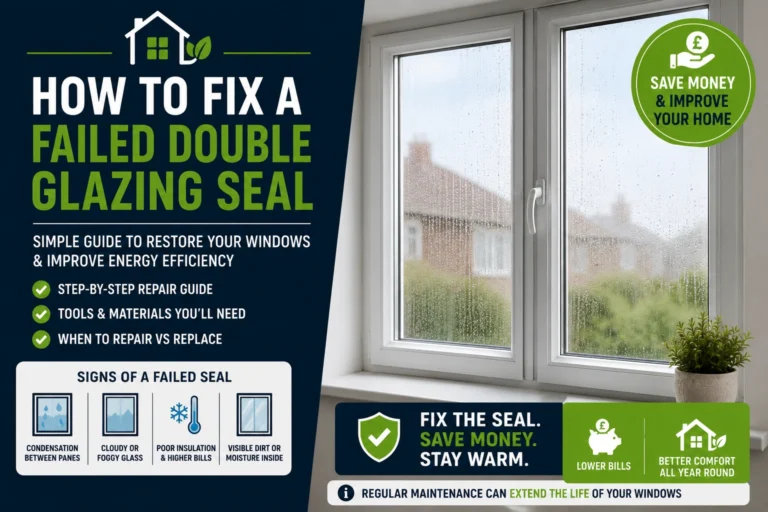
Condensation between the panes — sometimes called a “misted” or “blown” unit — means the hermetic seal has failed. Moist ambient air has entered the cavity and, when it meets the cold inner glass surface, the water vapour condenses. You’ll recognise it as a persistent milky haze, water droplets, or streaky smearing that cannot be wiped away from either side of the glass.
Condensation inside the sealed cavity is a structural failure — it will not clear on its own, will worsen over time, and indicates that the thermal and acoustic insulation the unit provides is significantly compromised.
When Condensation Is Normal — and When It’s Not
Not all window condensation signals a problem. Understanding the difference can save you an unnecessary call to a glazier.
External Condensation (Outside Surface) — Normal
Condensation on the outer pane of a double glazed window is, counterintuitively, a sign your windows are working well. When the outer glass is cold enough (because heat is being held inside, as intended) and the ambient air is warm and humid, moisture deposits on the exterior. This typically appears on clear mornings and evaporates within an hour or two as the sun warms the glass.
The Energy Saving Trust notes that external condensation is more common on high-performance windows precisely because they retain so much interior heat that the outer pane remains very cold relative to the air outside. [EST]
Internal Condensation (Interior Room-Facing Surface) — Manageable
Condensation on the room-facing side of the glass — the surface you can touch — occurs when indoor humidity is too high. This is common in kitchens, bathrooms and poorly ventilated rooms. It can usually be addressed through improved ventilation and humidity control (see the humidity guide below). While not a seal failure, persistent internal surface condensation can lead to mould growth on frames and reveals.
Between-Pane Condensation — Always a Problem
Moisture trapped inside the unit, between the two glass layers, is never normal. It does not clear on its own. The seal has failed. Action is needed.
The UK’s double glazing boom occurred primarily in the 1980s–2000s. With seal life typically spanning 15–20 years, a significant proportion of the country’s housing stock now has windows that are approaching or past their expected seal lifespan. If your windows were installed before 2005, inspection is strongly recommended.
Diagnostic Flowchart: Identify Your Condensation Type
Use this simple step-by-step check before calling a professional. Knowing your condensation type will allow you to communicate clearly with glaziers and avoid being upsold unnecessary work.
What Causes Condensation Between Double Glazing Panes?
1. Seal Failure (Primary Cause)
The perimeter seal of a sealed glazing unit is composed of two layers: a primary seal (usually butyl) and a secondary structural seal (typically polysulphide, polyurethane or silicone). Both degrade over time due to UV exposure, thermal cycling (the repeated expansion and contraction of glass through seasons), physical stress, and simple material fatigue. When either seal fails, the moisture barrier is broken.
According to the Glass and Glazing Federation (GGF), most sealed unit failures are attributable to edge seal degradation, and the expected life of a well-manufactured sealed unit ranges from 15 to 25 years under normal UK conditions. [GGF]
2. Desiccant Saturation
The spacer bar running around the perimeter of the sealed unit contains a desiccant material — typically silica gel or molecular sieve — that absorbs any residual moisture inside the cavity during manufacture and in the early life of the unit. Once the seal fails and moisture enters freely, the desiccant becomes fully saturated and can no longer prevent condensation. At this point, the milky or foggy appearance becomes permanent.
3. Poor-Quality or Incorrect Installation
Seals can fail prematurely if windows are installed incorrectly: inadequate distance from the frame edge, contact with incompatible frame sealants, or physical stress introduced during fitting. The FENSA certification scheme exists precisely to ensure installations meet Building Regulations and industry standards — always use a FENSA-registered installer. [FENSA]
4. Physical Damage
Impact damage — even minor chips or cracks to the edge of the glass — can compromise the seal integrity, particularly at corners where stress concentrations are highest.
5. Frame Degradation
Warped or rotten timber frames can place stress on the glazing unit’s perimeter, accelerating seal failure. This is more common in older properties with softwood frames that have been inadequately maintained.
How a Failed Seal Affects Your Home
Reduced Thermal Performance
A standard argon-filled double glazed unit has a centre-pane U-value of approximately 1.1–1.2 W/m²K. When the seal fails, the argon dissipates and is replaced by moist air, degrading the U-value significantly — studies suggest the thermal performance can revert towards that of a single-glazed unit (approximately 5.0 W/m²K) in a severely compromised unit. For a typical UK semi-detached home, this can represent a measurable increase in heating demand.
Visual Deterioration
The progressive mineral deposits left by evaporating moisture cause permanent etching and staining on the inner glass surfaces over time. Eventually, even if the unit were resealed, the visual clarity cannot be restored without replacing the glass.
Frame and Structural Damage
Persistent moisture at the glazing perimeter accelerates deterioration of timber frames (rot), PVCu frames (discolouration and mould), and aluminium frames (oxidation). Left unaddressed, frame replacement — rather than just unit replacement — may become necessary, significantly increasing costs.
Energy Loss Data: The True Cost of a Failed Seal
The Energy Saving Trust estimates that windows are responsible for approximately 18% of heat loss in a typical UK home. [EST] Double glazing reduces this loss by trapping a layer of insulating gas between the panes. When that gas is lost to seal failure, a window’s thermal resistance drops sharply.
- Estimated 10–15% increase in heat loss through a failed sealed unit compared to an intact unit — figures vary by unit size, age and degree of seal failure [EST]
- U-value deterioration: an intact argon unit ≈ 1.1 W/m²K; a failed unit where gas has fully dissipated can approach the performance of a single-pane window (≈ 5.0 W/m²K) in a worst-case scenario, though partial failure is more typical
- Annual energy cost: for a home with multiple failed units, the additional heating demand can be meaningful — the Energy Saving Trust’s online calculator can provide a property-specific estimate
- 0% VAT may apply to qualifying window replacement work under HMRC’s energy-saving materials scheme until 31 March 2027 — eligibility depends on the specific work and product; confirm with your installer [HMRC]
It is worth noting that new A-rated double glazing, or modern triple glazing, offers substantially better performance than what most UK homes installed 20–30 years ago. The Energy Saving Trust provides an online calculator to estimate savings specific to your property type, location and current glazing. [EST]
Mould Risk and Health Implications
Condensation — wherever it occurs on or around windows — raises localised humidity. Persistent surface moisture on window reveals, sills, plasterwork and curtains creates conditions favourable for mould growth. This is not a cosmetic inconvenience: it is a health matter.
The NHS advises that living in a damp, mouldy environment can cause nasal congestion, sore throats, coughing and wheezing, and exacerbate conditions such as asthma and eczema. In vulnerable groups — including infants, the elderly, and those with existing respiratory conditions — mould exposure can cause more serious respiratory infections. [NHS] If mould is visible in your home, remediation is a health priority, not merely an aesthetic one.
The most common species found in UK homes with condensation problems is Cladosporium and Aspergillus. Black mould (Stachybotrys chartarum) is less common but can colonise persistently damp plasterwork. If you have mould growth around window frames alongside condensation, address both the source of moisture and the mould itself — surface cleaning alone is insufficient if humidity remains elevated.
Ventilate, heat and fix the source. The NHS and local authority housing guidance consistently identifies these three actions as the primary response to damp and mould in homes. [NHS]
Indoor Humidity Guidance: The 40–60% Rule
While between-pane condensation is caused by seal failure rather than indoor humidity, surface condensation on windows — and the mould risk it creates — is directly driven by how much moisture is in the air inside your home.
A basic digital hygrometer (available for £5–£15 online) will tell you the relative humidity in any room. Readings consistently above 65% demand action, particularly in bedrooms and living areas.
Practical Steps to Reduce Indoor Humidity
- Use extractor fans when cooking and showering — and run them for 15–20 minutes afterwards
- Dry laundry outdoors where possible; a single load of damp washing releases approximately 2 litres of water vapour into the air
- Use lids on pots when cooking to contain steam
- Ventilate daily — even 10 minutes of cross-ventilation in cool weather significantly lowers humidity
- Use a dehumidifier in chronically damp rooms; a standalone unit costs £40–£150 and can remove several litres per day
- Heat consistently — cold rooms encourage condensation; keeping temperatures stable is more effective than intermittent high heat
Cost Comparison: Your Repair Options Explained
If you have confirmed between-pane condensation (seal failure), there are three main repair routes. Costs below are approximate early-2026 UK figures for a standard 600mm × 900mm double glazed unit; actual prices vary by window size, glass specification, location and installer.
| Option | Typical Cost | What’s Involved | Best For | Lifespan | Rating |
|---|---|---|---|---|---|
| Professional Seal Re-injection / Ventilation Kit | £80 – £150 per unit |
Technician drills small holes, purges moisture, installs vent plugs. Does not restore argon fill or full insulation. | Cosmetic fix when budget is tight; does not fully restore thermal performance | 2–5 years typically | Partial Fix |
| Sealed Glass Unit Replacement | £150 – £300 per unit |
Existing frame retained; only the glass cassette is removed and replaced with a new sealed unit. Full insulation restored. | Frames in good condition; most cost-effective permanent solution | 15–25 years | Recommended |
| Full Window Replacement | £400 – £600+ per window |
Complete removal and replacement of frame and glass. Required when frames are damaged, warped or rotting. | Old or damaged frames; upgrading to A-rated or triple glazing; full U-value improvement | 20–30 years | Best Value Long-Term |
Under current HMRC rules, window replacements that meet energy efficiency criteria (e.g. A-rated double or triple glazing) may qualify for 0% VAT rather than the standard 20%, a concession currently in place until 31 March 2027. Eligibility depends on the specific work carried out and the products installed — not every repair or replacement scenario qualifies. Always confirm VAT treatment with your installer before accepting a quote and check the current rules directly. See HMRC guidance → [HMRC]
For a whole-house assessment and multiple unit replacement, glazing companies will often offer a per-unit discount on volume. It is always worth collecting at least three quotes. Use a FENSA-registered or Certass-certified installer to ensure the work complies with Building Regulations and comes with a guarantee — typically 10 years on the sealed unit. [FENSA, Certass]
In practice, most homeowners only need to replace the sealed glass unit — full window replacement is less common unless frames are damaged, warped or rotting. Don’t let anyone push you towards a full replacement before a glazier has assessed your frame condition. If in doubt, get a second opinion.
Should I Repair or Replace? Quick Decision Guide
Not every misted window demands the same response. Use this table to orient yourself before requesting quotes — it will help you have a more informed conversation with a glazier and avoid being steered towards more expensive work than you need.
| Your Situation | Best Option | Approx. Cost | Priority |
|---|---|---|---|
| Glass misted but frame is sound, no draughts | Replace sealed glass unit only — retain existing frame | £150–£300 | Best Value |
| Frame is warped, rotten, draughty or damaged | Full window replacement — frame and glass together | £400–£600+ | Necessary |
| Budget is tight; misting is cosmetic only | Temporary de-misting service (drilled ventilation kit) — buys time, does not restore thermal performance | £80–£150 | Short-Term Only |
| Window is under 10 years old | Check manufacturer and installer warranty before paying for any repair — seal failure within warranty period should be covered at no cost | £0 if covered | Check First |
| Multiple windows failing across the house | Bulk sealed unit replacement — volume discount often available from glaziers; consider upgrading to A-rated units throughout | Negotiate | Best Long-Term |
| Condensation only on outer pane surface, clears by mid-morning | No action required — this is external condensation, a sign your windows are performing correctly | £0 | Normal |
Permanent Fixes in Detail
Option 1: Sealed Unit Replacement (Most Common)
For windows where the frame is structurally sound — no rot, warping or significant draughtiness — replacing only the sealed glass cassette is the most cost-effective permanent repair. A glazier will remove the beading (the trim strip holding the glass in the frame), slide out the old unit, fit a new sealed unit of the correct dimensions and specification, and refit the beading.
A new unit should be filled with argon gas and carry a manufacturer’s warranty — typically 10 years on the seal. Always ask for this in writing.
👉 See our detailed guide: Replacing Just the Glass in a Double Glazing Unit
Option 2: Full Frame and Glass Replacement
Where frames are damaged, where you are upgrading to a higher specification (e.g. A++-rated or triple glazing), or where the existing unit is non-standard and difficult to source, full window replacement is warranted. This work must comply with Building Regulations — specifically Part L (conservation of fuel and power) and Part N (glazing safety). Your installer must either be FENSA or Certass registered (self-certifying) or apply for Building Regulations approval from your local authority. [Gov.UK]
What to Avoid: DIY Re-injection Kits
Consumer DIY condensation repair kits — involving drilling and inserting ventilation plugs — do exist and are available online for £10–£25. While they can clear the visual appearance temporarily, they do not restore the sealed, argon-filled nature of the unit. Thermal performance is not recovered and the unit will typically become misted again within a few years. They are appropriate only as a short-term cosmetic measure when budget constraints prevent proper repair.
Preventing Future Condensation: A Homeowner’s Checklist
- Annual visual inspection: Check all sealed units in spring and autumn for early signs of misting, particularly on north-facing windows which experience more temperature differential.
- Clean seals gently: Use a soft cloth with mild soapy water. Avoid solvent-based cleaners on or near the perimeter seal — they can accelerate degradation.
- Check frame drainage: PVCu and aluminium frames have small drainage channels at the base. Ensure these are clear of debris to prevent water pooling at the glazing perimeter.
- Maintain paintwork on timber frames: Bare or cracking timber accelerates rot and movement, placing stress on the glazing seal. Repaint every 3–5 years.
- Monitor indoor humidity: Keep relative humidity between 40–60% using adequate ventilation and heating.
- Act on warranty: Most sealed units carry a 10-year manufacturer’s warranty against seal failure. If your windows are under 10 years old and showing signs of misting, check your documentation before paying for repairs.
- Use FENSA or Certass-registered installers: Any future window work should be carried out by a certified installer to ensure compliance and guarantee coverage.
👉 Download our complete annual maintenance schedule: Double Glazing Maintenance Checklist
Most quote requests take under 60 seconds — and you’ll immediately see whether a repair or full replacement is recommended for your windows.
Ready to Fix Your Misted Windows?
Get up to 4 free, no-obligation quotes from certified glaziers in your area. Or use our cost calculator to estimate your repair costs first.
Get Free Quotes →Frequently Asked Questions
- [EST] Energy Saving Trust — Windows and doors energy efficiency guidance. energysavingtrust.org.uk
- [NHS] NHS — Can damp and mould affect my health? nhs.uk/common-health-questions/lifestyle/can-damp-and-mould-affect-my-health/
- [HMRC] HMRC — VAT on energy-saving materials (0% VAT on qualifying installations). gov.uk/guidance/vat-on-energy-saving-materials
- [Gov.UK] GOV.UK — Building Regulations approval. gov.uk/building-regulations-approval
- [FENSA] FENSA — Competent Person Scheme for window and door installation. fensa.org.uk
- [GGF] Glass and Glazing Federation — Industry standards and best practice for sealed units. ggf.org.uk
- [Certass] Certass — Competent Person Scheme (alternative to FENSA). certass.co.uk
- [1] Double glazing prevalence in UK homes: widely cited via ONS English Housing Survey data and industry reports.
- [2] Seal lifespan 15–20 years: GGF industry guidance and manufacturer warranty data.
- [3] 10–15% heat loss increase: Energy Saving Trust modelling and independent glazing research cited by GreenMatch. greenmatch.co.uk/windows