If you are trying to work out whether you can get help with replacement windows in 2026, you are not alone. A lot of homeowners are seeing rising energy bills, older windows that no longer do the job properly, and a confusing mix of outdated guides online.
The short version is simple.
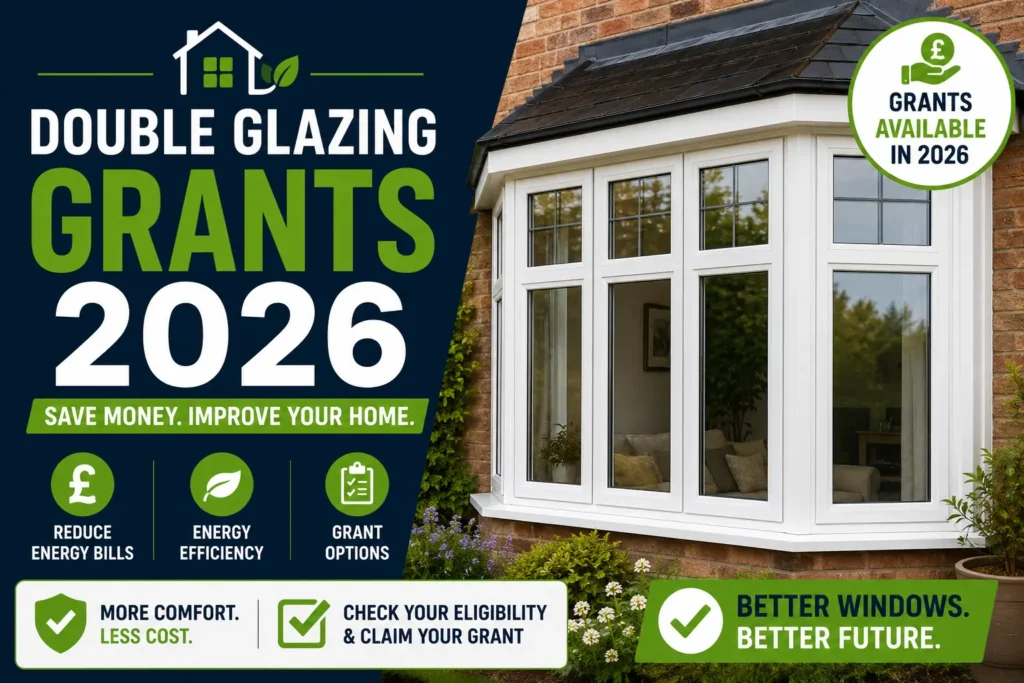
Yes, some households may be able to get help with double glazing in 2026, but it depends on where you live, your income, your home’s EPC rating, and the outcome of an energy assessment.
For many households in Great Britain, the main scheme to check first is ECO4, which now runs until 31 December 2026. In England, some households may also be able to get help through the Warm Homes: Local Grant, which is delivered through local councils. Scotland, Wales and Northern Ireland each have their own routes too.
The key thing to know is this: most schemes do not offer a simple blanket promise of free windows. In many cases, support is based on what improvements are judged suitable for your home after assessment.
Quick answer: Are double-glazing grants available in 2026?
They can be, yes.
If your home is hard to heat, has a poor EPC rating, or your household is on a lower income or certain benefits, you may be able to get support with energy efficiency upgrades that include window replacement.
The schemes worth checking are:
- ECO4 in Great Britain
- Warm Homes: Local Grant in England
- Home Energy Scotland for Scottish households
- Nest in Wales
- Affordable Warmth and related support in Northern Ireland
If you already have working double glazing, funding may be harder to get than if your home still has single glazing or clearly failing windows. If you find you don’t qualify for help, you can check our guide on [/double-glazing-costs-in-the-uk/](typical double glazing costs in the UK) to help you budget for the work yourself.
Which schemes are relevant in 2026?
| Scheme | Area | Status | What to know |
|---|---|---|---|
| ECO4 | Great Britain | Active until 31 December 2026 | Main supplier-led scheme for eligible households |
| Great British Insulation Scheme | Great Britain | Closed | Closed to new applications on 31 March 2026 |
| Warm Homes: Local Grant | England | Active | Council-delivered support for eligible households |
| Home Energy Scotland | Scotland | Active | First point of contact for advice and support |
| Nest | Wales | Active | Welsh Government advice and home energy support scheme |
| Affordable Warmth | Northern Ireland | Active, check local availability | Support route for eligible households in Northern Ireland |
ECO4 is the first place most people should check
For many readers, ECO4 is the most important scheme to understand.
According to Ofgem, ECO4 is the current Energy Company Obligation scheme and is due to run until 31 December 2026. It is designed to help improve the energy efficiency of homes, especially where households are on lower income or are more vulnerable to living in a cold home.
This is where a lot of articles get too bold. ECO4 does not mean every eligible household automatically gets free double glazing. Ofgem is clear that this is not a simple cash grant paid directly to the homeowner. The work offered depends on the property, the assessment, and what a participating supplier agrees to fund.
That said, if your home has poor-performing windows and the assessor decides that replacement would meaningfully improve energy efficiency, window upgrades may be considered as part of the package.
Who may qualify for ECO4?
You may be eligible if someone in your household receives a qualifying benefit. These can include benefits such as:
- Universal Credit
- Housing Benefit
- Pension Credit
- Income Support
- income-related ESA
- income-based JSA
- Child Benefit, in some cases
There is also ECO4 Flex, which is important because it can help some households who are not on those benefits.
Ofgem says ECO4 Flex may apply where a household:
- has a gross annual household income under £31,000, or
- includes someone with a health condition that is made worse by living in a cold home
If you think you might qualify, it is worth checking even if you assumed you would be outside the rules.
Can ECO4 cover double glazing?
Sometimes, yes, but do not treat it as guaranteed.
The safest way to explain it is this:
Window replacement may be considered under ECO4 where it forms part of the right energy-efficiency improvements for the home, but approval depends on the assessment and delivery decision.
In practice, you are more likely to have a strong case if:
- your home still has single glazing
- your existing windows are clearly old and inefficient
- there are failed units or significant heat loss
- the windows are part of a wider plan to improve the home’s energy performance
Warm Homes: Local Grant in England
If you live in England, the Warm Homes: Local Grant is another scheme worth checking.
The government application page says this scheme can help some eligible households get free energy-saving home improvements through their local council.
To qualify, your home must usually:
- be in England
- be privately owned, either owner-occupied or privately rented
- have an EPC rating of D, E, F or G
Your household income must usually be £36,000 a year or less, although the rules can vary slightly and some households may still qualify based on benefits or postcode criteria.
The government says councils may offer improvements such as:
- loft, wall and underfloor insulation
- air source heat pumps
- solar panels
- heating controls
The broader policy guidance says measures should be tailored to the property, so again, do not assume window replacement will always be offered as a standalone improvement. It may be included in some cases, but not all.
Support in Scotland, Wales, and Northern Ireland
Scotland
If you are in Scotland, the most sensible first step is to contact Home Energy Scotland. This is the official advice service and it can point you towards the right support based on your circumstances and property type.
- Freephone: 0808 808 2282
Wales
In Wales, the official route is Nest, the Welsh Government’s home energy support scheme. It offers free advice and may help eligible households access energy-saving improvements.
- Freephone: 0808 808 2244
Northern Ireland
Northern Ireland has its own support routes, including the Affordable Warmth scheme aimed at eligible households living in privately owned homes.
- NI Energy Advice: 0800 111 4455
What if you don’t qualify for a grant?
Many people find they are just outside the eligibility criteria for government help. If that happens, it is still worth evaluating the [/the-roi-of-installing-double-glazing/](ROI of installing double glazing), as the energy savings and property value increase can often justify the upfront cost.
If the main barrier is the initial payment, you can also explore different [/window-finance/](window finance options) that allow you to spread the cost over several years.
A quick correction on VAT
This is one area where some consumer articles get it wrong.
Do not tell readers that replacement double glazing automatically qualifies for 0% VAT as an energy-saving material.
According to HMRC VAT Notice 708/6, the installation of secondary or double glazing is standard-rated, not zero-rated under the energy-saving materials relief.
How to check if you might be eligible
If you are serious about applying, start with these five checks.
- Check your EPC: Find out your current rating using the GOV.UK EPC register.
- Check your benefits and income: See if you receive a qualifying benefit or if your income is below the relevant thresholds.
- Think about window condition: Single glazing or significant heat loss may strengthen your case.
- Consider your housing situation: Private tenants will usually need a landlord’s agreement.
- Contact the right scheme directly: Use the official routes for your nation or local area.
Final answer
If someone asks, “Can I get free double glazing in the UK in 2026?”, the most accurate answer is:
Possibly, but only in some cases.
There is real support available in 2026, but it is not a universal free window scheme. Whether you can get help depends on your location, your household circumstances, your home’s energy rating, and what an assessor decides will genuinely improve the property.
Frequently Asked Questions
Are double glazing grants still available in 2026?
Some households may still be able to get help with window replacement in 2026, usually through wider energy-efficiency schemes such as ECO4 or local authority support. Approval depends on eligibility and assessment.
Does ECO4 definitely pay for new windows?
Not definitely. Window replacement may be considered in some cases, but the work approved depends on the property assessment and the supplier’s delivery rules.
Is ECO4 still open?
Yes. Official government and Ofgem sources say ECO4 runs until 31 December 2026.
What replaced GBIS?
GBIS has closed to new applications. People looking for current support should check active schemes such as ECO4 and, in England, the Warm Homes: Local Grant.
Does replacement double glazing get 0% VAT?
No. HMRC guidance says secondary or double glazing is standard-rated, not zero-rated under the energy-saving materials relief.
Sources
- Ofgem, Energy Company Obligation
- GOV.UK, Apply for the Warm Homes: Local Grant
- Home Energy Scotland
- HMRC, VAT Notice 708/6