Why Aluminium Windows Are the Future of Energy Efficiency: Smart, Sustainable & Built for the UK
Imagine cutting your energy bills while giving your home a sleek, contemporary edge. For UK homeowners, that combination is increasingly within reach, and aluminium windows are leading the charge.
Once the preserve of commercial tower blocks and architectural showpieces, aluminium frames are now firmly crossing into the residential mainstream. According to Insight Data’s 2024 Fenestration Market Overview, aluminium’s share of the UK window market has jumped from 12% to 18% in just five years, representing a 50% relative growth that no other window material can match right now. So what’s driving this shift, and should you be part of it?
This guide breaks down the energy performance, sustainability credentials, UK pricing, compliance requirements, and design advantages that are making aluminium the smart homeowner’s window of choice.
At a Glance: Aluminium vs uPVC
| Feature | Aluminium | uPVC |
|---|---|---|
| Typical lifespan | 30–50 years | 20–25 years |
| Upfront cost | Higher (40–60% premium) | Lower |
| Maintenance | Very low | Low to Moderate |
| Recyclability | Excellent (closed-loop) | Improving (70% recycled content) |
| Design flexibility | High: slim profiles, unlimited colour | Moderate: limited colour range |
| U-value (thermally broken) | 1.3–1.5 W/m²K | 1.2–1.6 W/m²K |
| Future Homes Standard readiness | Strong | Variable by specification |
The UK Energy Efficiency Landscape: Why Your Windows Matter More Than Ever
With UK energy bills still elevated following recent market volatility, the Energy Saving Trust estimates that poorly insulated windows can account for up to 18% of a home’s total heat loss. Multiply that across an average semi-detached property, and the annual cost impact is significant.
Building Regulations in England, specifically Approved Document L (Conservation of Fuel and Power), already mandate a minimum whole-window U-value of 1.4 W/m²K for replacement windows. But the horizon is shifting. The upcoming Future Homes Standard, due for full implementation by 2025–2026, is expected to move toward ~1.2 W/m²K or lower, according to GOV.UK building regulations guidance, though the precise final specification is still evolving. Modern aluminium systems with thermal break technology are already performing well within that anticipated range, making them a genuinely future-proof investment rather than a short-term fix.
Thermal Break Technology: The Science Behind the Savings
Early aluminium windows had a well-earned reputation for cold frames and condensation. Solid aluminium is an excellent conductor of heat, which is exactly what you don’t want in a window frame. But thermal break technology has transformed this entirely.
A thermal break inserts a section of low-conductivity polyamide material between the inner and outer aluminium profiles, disrupting the path heat would otherwise travel. The result? Modern thermally broken aluminium windows achieve U-values of 1.3–1.5 W/m²K, comfortably within current Building Regulations and already aligned with Future Homes Standard requirements when paired with the right glazing specification.
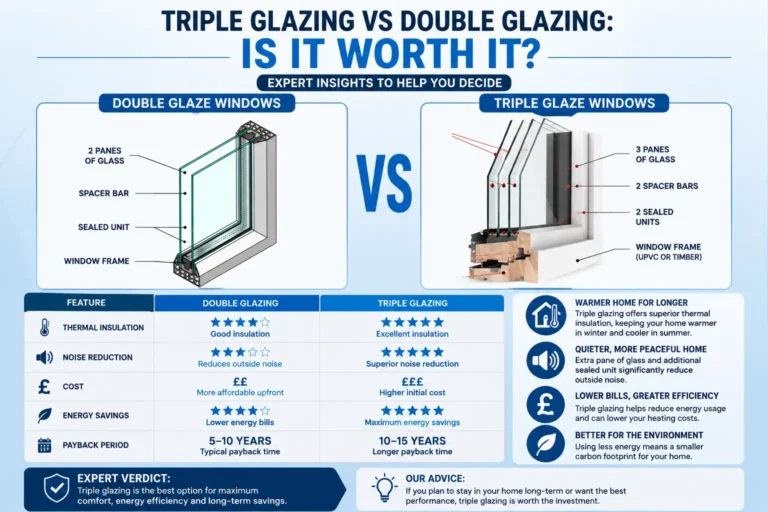
The Glass and Glazing Federation (GGF) confirms that thermal break systems, combined with double or triple glazing filled with argon or krypton gas, represent the current gold standard for residential fenestration performance. Triple-glazed aluminium units can push U-values below 1.0 W/m²K in premium configurations, well beyond regulatory minimums and approaching levels associated with ultra-low-energy homes.
For homeowners wanting an even deeper dive into glazing specifications and performance ratings, the BRE Group publishes technical guidance on window energy ratings (WERs) that can help you compare products on a like-for-like basis before purchase.
UK Pricing: What Does Aluminium Actually Cost?
Honesty first: aluminium windows carry a premium over uPVC. As a general rule, aluminium frames cost 40–60% more than equivalent uPVC units in the UK market. For a typical three-bedroom semi-detached home requiring eight to ten windows, you might expect:
| Window Type | Estimated Cost (Supply & Fit) |
|---|---|
| uPVC double glazed | £4,500 – £7,000 |
| Aluminium double glazed | £7,000 – £11,000 |
| Aluminium triple glazed | £9,500 – £14,500 |
Figures are indicative UK averages. Costs vary by region, property type, and specification. Always obtain multiple quotes.
These figures are consistent with data from GreenMatch and Which?’s window buying guide. The gap narrows when you factor in whole-life costs: aluminium frames carry a 30–50 year lifespan with minimal maintenance, whereas uPVC typically requires replacement every 20–25 years and has more limited recyclability.
One financial tailwind worth exploring: some qualifying window installations may benefit from a 0% VAT rate under HMRC’s energy-saving materials relief scheme, currently running until March 2027, depending on the property type and installation scope. See HMRC’s VAT guidance on energy-saving materials for the eligibility criteria, and always confirm with your installer before budgeting on this basis.
MoneySavingExpert also recommends checking eligibility for schemes such as the Great British Insulation Scheme and ECO4, which may provide partial funding for window upgrades in qualifying properties, worth investigating before committing to full out-of-pocket expenditure.
Sustainability: A Balanced View
Aluminium’s green credentials are genuinely compelling, but it’s worth presenting the full picture rather than just the headlines.
The case for aluminium: Aluminium is infinitely recyclable without quality degradation. Recycling aluminium uses up to 95% less energy than producing virgin metal, a stat corroborated by the Energy Saving Trust and consistently cited across the industry. At the end of life, aluminium window frames are almost entirely reclaimed and re-entered into the production cycle. This closed-loop potential is one reason aluminium scores well in whole-life carbon assessments conducted by bodies like the BRE Group.
The balanced view on uPVC: It would be misleading to dismiss uPVC entirely on sustainability grounds. Around 70% of uPVC window frames now contain recycled material, and the industry has made significant strides in closed-loop recycling schemes. The Glass and Glazing Federation actively promotes uPVC recyclability, and for many homeowners on tighter budgets, a high-quality uPVC triple-glazed unit may represent the better whole-life environmental choice compared to entry-level aluminium.
The honest summary: for homeowners prioritising long-term sustainability, premium performance, and circular economy alignment, aluminium edges ahead. For budget-conscious buyers who still want strong energy performance, modern uPVC remains a credible option. For those in rented properties or working with tight retrofit budgets, secondary glazing offers a cost-effective alternative worth exploring. For a comprehensive side-by-side breakdown of all three main frame materials, see our guide to uPVC vs aluminium vs timber: the ultimate UK window material showdown.
Design Advantages: Why Architects and Homeowners Are Choosing Aluminium
Thermal performance aside, aluminium’s design flexibility is a major draw, particularly for modern, open-plan homes where sight lines and natural light matter.
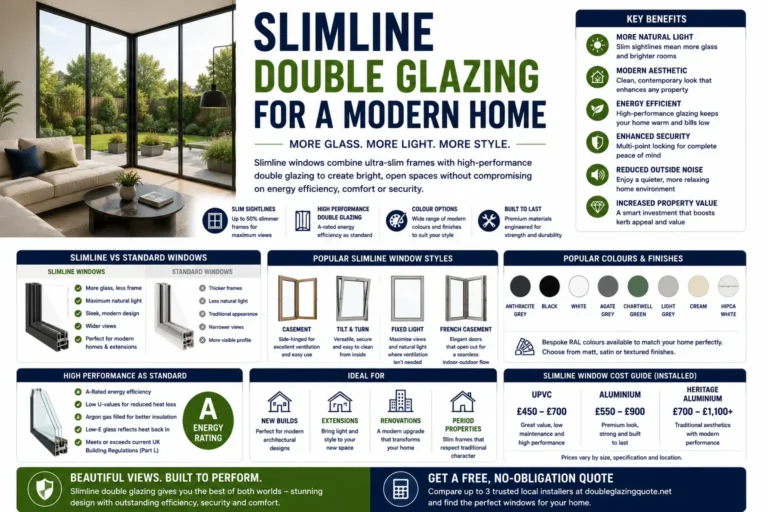
Slimline profiles are perhaps aluminium’s most talked-about aesthetic feature. Aluminium frames can be engineered far thinner than uPVC or timber equivalents because the material’s inherent strength requires less cross-section. The result is a larger glazed area per opening, typically 15–20% more glass, flooding interiors with light. If you’re exploring slimline options for a contemporary renovation, our guide to slimline double glazing for a modern home covers the key specifications to look for.
Powder-coating technology gives aluminium almost unlimited colour flexibility. From RAL-matched heritage greens and blues to bold anthracite or soft warm greys, the finish is baked on and resistant to UV fade, corrosion, and chalking. This is a significant advantage over uPVC, which offers a narrower range and can discolour over time under direct sun.
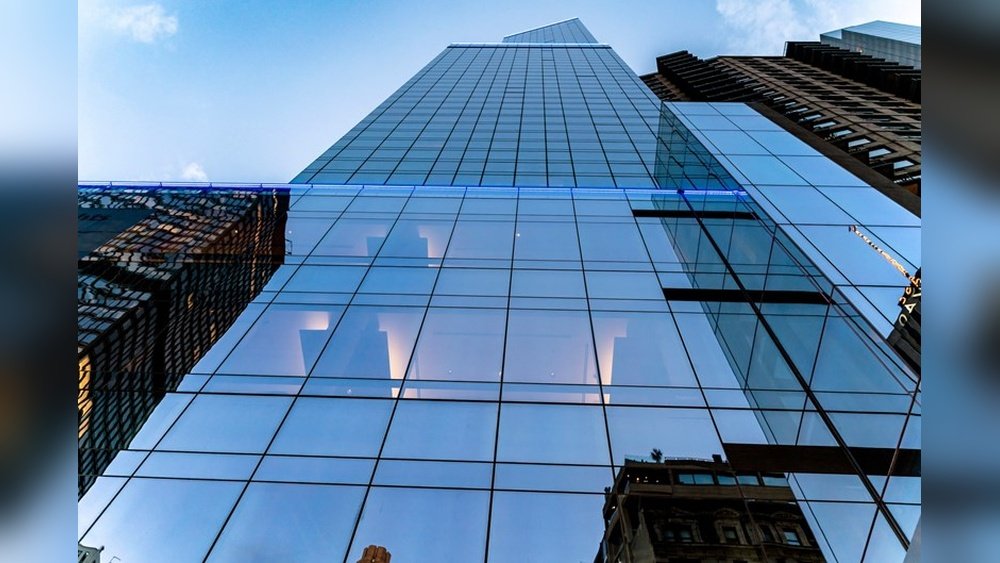
Structural strength allows aluminium frames to span large openings without additional reinforcement, making them the preferred choice for bifold and sliding doors, large picture windows, and floor-to-ceiling glazing configurations that would require bulkier profiles in other materials.
UK Manufacturer Recommendations
Not all aluminium window systems are equal. The UK market has several well-regarded manufacturers whose systems offer strong thermal performance, robust warranties, and wide installer networks:
- Origin: UK-based manufacturer known for high-quality bifold doors and windows, with strong thermal break specifications and a comprehensive 20-year guarantee.
- Smart Systems: One of the UK’s largest aluminium systems suppliers, offering a broad product range including Alitherm windows with excellent U-value performance.
- Reynaers: Belgian-headquartered but with a strong UK presence, Reynaers systems are widely specified on high-end residential and commercial projects, with CP 130-S achieving outstanding thermal results.
When selecting an installer, ensure they hold certification from either FENSA (Fenestration Self-Assessment Scheme) or Certass. Both schemes authorise competent installers to self-certify replacement window installations under Building Regulations without requiring a separate Local Authority building notice, saving time, cost, and administrative friction.
Future Trends: Smart Glass and the Connected Home
The next frontier for aluminium windows goes beyond passive insulation. Smart window technologies (electrochromic and thermochromic glass that adjusts tint in response to light levels or electrical signals) are moving from commercial specification into residential reach.
Aluminium frames are uniquely well-suited to smart glass integration: their structural rigidity supports the electrical connections and heavier glass units these systems require, while their slim profiles preserve sightlines even with the additional glass thickness.
Integration with building automation systems, linking windows to heating controllers, ventilation systems, and solar shading, is already available on premium aluminium products. As the Future Homes Standard drives down permitted carbon emissions from new and retrofitted homes, these smart systems will become increasingly mainstream rather than niche.
Installation Best Practices and Regulatory Compliance
Even the best-performing aluminium window system will underperform if poorly installed. Air leakage around the frame is a primary cause of real-world performance falling short of theoretical U-values. The Glass and Glazing Federation recommends ensuring:
- Frames are installed plumb, level, and square, with no distortion
- All perimeter gaps are filled with low-expansion insulating foam and finished with compatible sealant
- Weatherstripping is correctly seated and makes continuous contact throughout the opening
- Certification paperwork (FENSA or Certass certificate) is issued on completion and registered with the Local Authority
Retain your installation certificate. It is required documentation when selling your property and may be requested by insurers following any future claims.
Common Drawbacks to Consider
No window material is perfect, and aluminium is no exception. Being upfront about the limitations is part of making a well-informed decision.
Higher upfront cost is the most common barrier. Even with 0% VAT on qualifying installations, aluminium can run 40–60% more than equivalent uPVC, a meaningful sum on a whole-house project.
Cold-touch feel at the frame can still occur in budget aluminium systems without adequate thermal breaks. Always verify the thermal break specification before purchasing; a reputable installer should be able to provide the system datasheet.
Installation sensitivity is real. Unlike uPVC, which is relatively forgiving, aluminium demands a skilled and experienced installer to avoid thermal bridging at fixing points and ensure a perfectly sealed perimeter. This is another reason why FENSA or Certass registration matters. It is not just a regulatory tick-box.
Heritage and conservation area restrictions apply in many parts of the UK. Aluminium’s contemporary aesthetic can conflict with planning authority requirements for listed buildings or Conservation Areas, where traditional timber or sash profiles may be required. For period properties where aluminium is not suitable, sash windows remain the dominant and often required choice. Always check with your Local Planning Authority before ordering. Your installer should also be familiar with GOV.UK planning guidance on permitted development rights for window replacements.
How to Get Accurate Aluminium Window Quotes in the UK
Pricing varies heavily based on property type, access, and specification, which means online averages can only take you so far.
To get a reliable figure:
- Request at least three quotes from FENSA or Certass-registered installers
- Ask for full U-value specifications, not just “double-glazed”
- Confirm whether VAT relief applies to your specific installation
- Check whether scaffolding or access costs are included in the quote
- Always request written specifications alongside the quote, so you can compare like-for-like across installers rather than headline price alone
For a fast starting point, you can compare verified installer quotes at doubleglazingquote.net.
The Bottom Line: Is Aluminium Worth It?
The upfront premium over uPVC is real, typically 40–60% higher. But the calculus shifts when you account for a 30–50 year lifespan, lower maintenance costs, strong alignment with Future Homes Standard direction, potential 0% VAT on qualifying installations, and the energy savings that the Energy Saving Trust consistently attributes to high-performance glazing upgrades.
With aluminium’s UK market share growing from 12% to 18% in five years, and tighter energy regulations on the horizon, the material’s trajectory is clear. For homeowners planning a long-term stay in their property, or seeking to maximise sale value and EPC rating, aluminium windows represent a genuinely compelling investment.
The smart move? Get multiple quotes, specify thermally broken systems with double or triple glazing, choose a FENSA or Certass-registered installer, and treat your windows not as a commodity purchase but as a decades-long investment in comfort, efficiency, and style.
Last updated: 2025. Pricing figures are indicative UK averages and subject to market variation. Always obtain at least three quotes from registered installers before committing to any window replacement project.