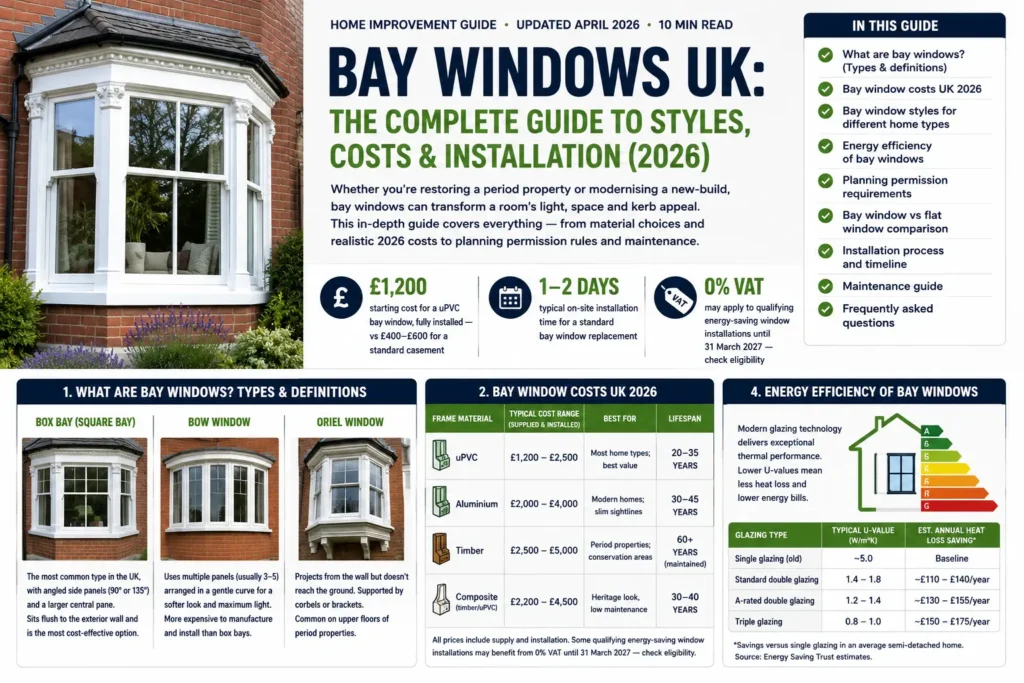
Bay Windows UK: The Complete Guide to Styles, Costs & Installation (2026)
Whether you’re restoring a period property or modernising a new-build, bay windows can transform a room’s light, space and kerb appeal. This in-depth guide covers everything — from material choices and realistic 2026 costs to planning permission rules and maintenance.
1. What Are Bay Windows? Types & Definitions
A bay window is an outward-projecting window structure that extends beyond the main wall plane of a building, creating a recess or alcove inside the room. Unlike a standard flat window, bay windows add physical floor space, flood interiors with multi-directional light, and — on a street elevation — are a defining architectural feature that significantly boosts kerb appeal.
Not all bay windows are the same. There are three distinct types commonly found across UK housing stock:
Box Bay (Square Bay)
The most prevalent type in the UK, featuring two angled side panels (typically at 90° or 135°) flanking a larger central pane. Box bays sit flush to the exterior wall and are especially common on Edwardian terraces and inter-war semi-detached houses. They’re the most cost-effective bay window style to install due to their relatively simple structural requirements.
Bow Window
A bow window uses multiple panels (usually 3–5) arranged in a gentle, continuous curve. The radius is more pronounced than a box bay, creating a softer, more elegant appearance. Bow windows suit Victorian and Georgian architecture particularly well, and they maximise light intake due to the wider arc. They are, however, more expensive to manufacture and install than standard box bays, with bespoke curved sections adding to material cost.
Oriel Window
An oriel is a projecting bay window that does not extend to the ground — it is supported from the wall by corbels, brackets, or a cantilevered structure. Oriel windows are most often seen on upper floors of Victorian townhouses, Gothic Revival buildings, and some Edwardian bay-fronted properties. They introduce significant structural complexity and are the least common type encountered in modern domestic renovation projects.
2. Bay Window Costs UK 2026
Bay windows represent a substantial uplift over standard flat-window replacements. For context, a single standard casement or casement window in the UK typically costs between £400–£600 supplied and fitted. A comparable bay window installation starts at roughly £1,200 and can exceed £5,000 depending on material, size, complexity, and glazing specification.
The principal cost drivers are: frame material, number of panes/panels, overall dimensions, glazing upgrade (double vs triple), and the structural work required to create or modify the bay opening. Labour also varies significantly — a straightforward box bay replacement is far less involved than installing a new oriel or bow window into an existing flat wall.
| Frame Material | Typical Cost Range | Best For | Lifespan |
|---|---|---|---|
| uPVC | £1,200 – £2,500 | Most home types; best value | 20–35 years |
| Aluminium | £2,000 – £4,000 | Modern homes; slim sightlines | 30–45 years |
| Timber | £2,500 – £5,000 | Period properties; conservation areas | 60+ years (maintained) |
| Composite (timber/uPVC) | £2,200 – £4,500 | Heritage look, low maintenance | 30–40 years |
All prices include supply and installation. Some qualifying energy-saving window installations may benefit from 0% VAT until 31 March 2027 — confirm eligibility with your installer and refer to HMRC guidance on VAT for energy-saving materials.
What Drives the Cost Up?
- Structural alteration — creating a new bay opening in an existing flat wall requires a structural engineer and could add £1,500–£4,000 to the project.
- Triple glazing — adds roughly 15–25% to the glazing cost but delivers U-values of 0.8–1.0 W/m²K, well ahead of the current Building Regulations minimum and expected to align comfortably with the emerging Future Homes Standard performance requirements.
- Bay window seat — a joinery-built internal seat/storage unit typically adds £400–£900.
- Roofing over the bay — a lead or tiled bay roof canopy adds £600–£1,500 to the installation.
- Conservation area or listed building — specialist materials and additional permissions add time and cost.
3. Bay Window Styles for Different Home Types
Getting the style right is as important as the technical specification. A bay window that clashes with your home’s architectural character can look jarring and reduce resale value. For owners of pre-1940 properties in particular, period-appropriate design is a key consideration — both for planning compliance and for protecting the character that makes older homes attractive to buyers.
Victorian Properties (1837–1901)
Victorian homes — especially bay-fronted terraces found throughout London, Birmingham, Manchester and Leeds — traditionally feature large box bays with sash windows and detailed timber surrounds. The classic combination is a box bay with flush casement or vertical sliding sash units in painted timber or high-quality composite. Avoid white uPVC on Victorian properties in conservation areas; it rarely satisfies planning officers and undermines the character of the street.
Edwardian Properties (1901–1914)
Edwardian houses often feature slightly wider, shallower bays than their Victorian predecessors, frequently with decorative leaded lights or stained glass in the upper panes. A sympathetic restoration uses timber or heritage composite frames with leaded detail inserts. Casement openers rather than sash are more architecturally appropriate for most Edwardian styles.
Inter-War Semi-Detached (1920–1940)
The classic “semi” is the most common property type in the UK and almost universally features a front-facing box bay. The Tudorbethan or Arts and Crafts influence means dark-stained or painted timber, leaded casements, and angular box bays are most appropriate. uPVC in a woodgrain finish can work well where budget is a constraint, particularly in non-conservation areas.
Post-War & Modern Homes
For homes built from the 1950s onward, the aesthetic priority shifts from period authenticity to contemporary performance. Aluminium bay windows with powder-coated anthracite grey or black finishes are highly popular in modern extensions and new-builds. Their slim sightlines maximise glass area and complement clean architectural lines. See our guide to matching window materials to architectural style for a deeper comparison.
4. Energy Efficiency of Bay Windows
Bay windows have a larger overall glass area than equivalent flat windows, which historically made them more susceptible to heat loss. Modern glazing technology has dramatically changed this equation — but specification choices matter enormously.
U-Values Explained
The U-value measures how readily a window loses heat (watts per square metre per degree Kelvin). The lower the number, the better the insulation. The UK Building Regulations currently require replacement windows to achieve a minimum U-value of 1.4 W/m²K (whole-window). The forthcoming Future Homes Standard is expected to push performance requirements further — most high-specification double and triple-glazed products already exceed current minimums comfortably.
| Glazing Type | Typical U-Value | Est. Annual Heat Loss Saving* |
|---|---|---|
| Single glazing (old) | ~5.0 W/m²K | Baseline |
| Standard double glazing | 1.4–1.8 W/m²K | ~£110–£140/year |
| A-rated double glazing | 1.2–1.4 W/m²K | ~£130–£155/year |
| Triple glazing | 0.8–1.0 W/m²K | ~£150–£175/year |
*Savings versus single glazing in an average semi-detached home. Source: Energy Saving Trust estimates; actual savings depend on home size, heating system, and energy tariff.
The Energy Saving Trust recommends looking for the BFRC Window Energy Rating label (Band A or above) when selecting bay windows. Low-emissivity (low-e) coated glass and argon-filled cavities are standard on quality double-glazed units and should be specified as a minimum.
5. Planning Permission Requirements
For most homeowners, bay window installation — particularly like-for-like replacement — falls under Permitted Development rights and does not require formal planning permission. However, there are important exceptions, and the rules differ depending on whether you’re replacing an existing bay or creating a new one.
When Planning Permission Is NOT Required
- Replacing an existing bay window with a new one of the same or smaller size
- Installing a new bay window that does not project beyond an existing bay footprint
- Work on properties not in a conservation area or listed building
- Single-storey bay additions not exceeding 3m projection from the original wall
When Planning Permission IS Required
- Properties in a Conservation Area — most window changes require prior approval
- Listed buildings — Listed Building Consent is required for any alterations to the fabric of the building
- Creating a new bay opening where none previously existed and the projection exceeds permitted development limits
- Flats, maisonettes, and properties where permitted development rights have been removed by a planning condition
Always check with your Local Planning Authority before proceeding. The Planning Portal provides an interactive tool to determine whether your project needs consent. Even where planning permission is not required, Building Regulations approval is almost always necessary for window replacements — refer to GOV.UK for Building Regulations guidance.
FENSA Certification & Building Regulations
Under UK Building Regulations (Part L for energy efficiency, Part K for safety glazing), all replacement windows must be installed by a competent person. The easiest way to comply is to use a FENSA-registered installer — they are authorised to self-certify that work meets Building Regulations, meaning you don’t need to apply separately to your local council for building control sign-off. Alternatively, Certass provides an equivalent competent-person certification scheme.
6. Bay Window vs Flat Window: Which Is Right for You?
Bay window advantages
- Adds usable floor space and seating area
- Significantly increases natural light from 3 directions
- Major kerb appeal and character
- Can meaningfully enhance property value on period homes (estate agents consistently cite bay windows as a sought-after feature)
- Wider panoramic views
- Creates attractive room focal point
Bay window considerations
- 3–5× more expensive than flat windows
- More complex installation (structural works)
- Bay roof may require separate maintenance
- Can be harder to dress with curtains/blinds
- Greater glass area = more cleaning required
- May need planning permission if new build-out
For the majority of pre-1970 UK homes, retaining or upgrading a bay window is almost always the right choice — architecturally, economically, and in terms of liveability. For modern homes without an existing bay, the cost-benefit calculation is more nuanced, and a flat picture window or wide casement may deliver comparable light with less structural disruption.
Bay windows are frequently cited by estate agents and renovation specialists as a desirable feature for buyers of older properties, reinforcing their importance to both liveability and long-term value.
7. Installation Process & Timeline
A standard bay window replacement — removing old units and fitting new frames into an existing bay opening — is typically completed within one to two days by an experienced team. More complex work involving structural alterations, bay roof replacement, or ornamental rendering repairs can extend this to a week or more.
A FENSA-registered installer surveys the existing bay, takes precise measurements of all three faces, checks the lintel and structural integrity, and provides a final specification. Templates are made for any bespoke curved bow elements.
uPVC bay windows are typically manufactured within 2–3 weeks. Timber and aluminium bespoke units can take 4–6 weeks. Bow windows with curved sections typically require the longest lead time.
The existing frames are removed carefully. The installer checks the reveal, sill, and lintel for damage. Any rot, damp, or structural defects are addressed before new frames go in.
New frames are set, levelled, and secured. The glazed units are inserted. Reveals are packed, insulated, and internally plastered or dry-lined. External gaps are pointed and sealed.
If the bay canopy roof is being replaced, a lead flat roof or new tiled slope is installed on Day 2. FENSA certificate is issued and handed to the homeowner on completion.
8. Bay Window Maintenance Guide
A well-maintained bay window should give decades of trouble-free service. Maintenance requirements vary significantly by material, but the fundamentals are consistent across frame types.
uPVC Bay Windows
The lowest-maintenance option. Clean frames with warm soapy water or a specialist uPVC cleaner every 3–6 months. Check and lubricate hinges, handles, and locking mechanisms annually with a silicone-based lubricant. Inspect the external sealant joints every couple of years and re-seal if cracking or shrinkage is visible.
Aluminium Bay Windows
Wash down with clean water and a soft cloth to remove traffic film and salt deposit, particularly in coastal areas. Inspect the thermal break seals every 5 years. Powder-coated aluminium rarely requires repainting within its typical 30–45-year lifespan, but scratches should be touched up promptly to prevent corrosion.
Timber Bay Windows
Timber requires the most active maintenance but rewards it with unmatched longevity. A well-maintained softwood bay will outlast uPVC; hardwood frames (oak, iroko) can last well over a century.
- Inspect paintwork annually and repaint every 5–8 years (earlier in exposed coastal locations)
- Check putty and glazing beads; replace if cracked or shrinking
- Apply an end-grain preservative to any exposed timber annually
- Keep drainage channels in the sill clear of debris to prevent pooling water
- Check for early signs of rot by probing with a small screwdriver around joints and the bottom rail
The Bay Roof
The flat or pitched canopy above a ground-floor bay is one of the most common sources of damp ingress in older homes. The NHS warns that damp and mould carry real health risks, particularly for those with respiratory conditions. Inspect the bay roof lead work or felt every spring. Any splits, cracks, or lifted flashings should be remedied promptly by a qualified roofer. A lead bay roof correctly installed will last 50–70 years; EPDM rubber alternatives offer similar longevity at lower cost.
Condensation
Some external condensation on double-glazed bay windows is normal, particularly in autumn and spring — it indicates the outer pane is cold (i.e. the glazing unit is doing its job of retaining heat). Internal condensation between the panes, however, indicates a failed sealed unit and the glazing will need replacing. The Eco Experts note that secondary glazing can be a cost-effective interim solution for reducing condensation in hard-to-treat period windows pending full replacement.
9. Frequently Asked Questions
How much does a uPVC bay window cost in the UK in 2026?
A standard uPVC bay window — supplied and installed — costs between £1,200 and £2,500 for most domestic properties. Larger windows, triple glazing, or bay openings requiring structural alteration will sit toward the top of this range or beyond. Compare this to a standard double-glazed casement at £400–£600. Always get at least three quotes from FENSA or Certass-registered installers.
Do I need planning permission to replace a bay window?
In most cases, replacing an existing bay window with a new one of similar size and appearance is covered by Permitted Development rights and does not require planning permission. However, properties in conservation areas, listed buildings, and situations where you are creating a new bay where none previously existed may all require formal permission. Check with your Local Planning Authority and use the Planning Portal’s interactive tool to confirm whether consent is needed.
What is the most energy-efficient bay window material?
From a thermal performance perspective, the glazing specification (double vs triple, low-e coating, gas fill) matters more than the frame material. That said, modern thermally-broken aluminium and high-spec uPVC frames both achieve excellent U-values. The Energy Saving Trust recommends looking for the BFRC Window Energy Rating label Band A or above as a reliable indicator of efficiency.
How long does bay window installation take?
A straightforward bay window replacement (existing bay, no structural changes) takes one to two days on site. More complex projects involving structural alterations, bay roof replacement, or rendered finishes may take up to five days. Lead time for manufacture runs between two and six weeks from order, depending on material and specification.
Will a bay window add value to my home?
Bay windows are widely regarded as a desirable feature on period homes — Victorian, Edwardian, and inter-war properties in particular. A well-specified installation can enhance buyer appeal and support resale value, though the exact uplift depends on location, condition, and the wider market. Estate agents and renovation specialists frequently cite bay windows as a positive factor for buyers of older properties.
Can I claim VAT relief on bay window installation?
Possibly — some qualifying energy-saving window installations in residential properties in Great Britain may benefit from 0% VAT (rather than the standard 20%) until 31 March 2027. Eligibility depends on the specific products and installation type. Always confirm with your installer before signing a contract, and check HMRC’s guidance on VAT for energy-saving materials for the current criteria.
What is the difference between a bay window and a bow window?
A bay window (more precisely a box bay) typically uses three flat panels — a wide central pane flanked by two angled side panels, forming a squared or angular projection. A bow window uses four or five panels arranged in a continuous arc, creating a more rounded, curved appearance. Bow windows suit grander Victorian and Georgian elevations; box bays are more common on standard terraced and semi-detached UK homes.
Sources & References
- Energy Saving Trust — Energy efficiency data, U-value guidance, and heat-loss savings estimates.
- GOV.UK — Building Regulations Approval — Planning permission guidance, Permitted Development rights, and Future Homes Standard.
- HMRC — VAT on Energy-Saving Materials — 0% VAT eligibility for energy-efficient glazing installations.
- FENSA — Fenestration Self-Assessment Scheme; installer certification and Building Regulations compliance.
- Glass and Glazing Federation (GGF) — Industry standards and best practice guidance.
- Certass — Alternative competent-person certification scheme for window installation.
- Which? — Double Glazing Reviews & Buying Guide — Independent consumer advice, company ratings, and product testing.
- MoneySavingExpert — Energy Saving Tips — Practical guidance on reducing energy costs and home energy improvements.
- GreenMatch — Windows — Cost comparison data and energy efficiency metrics.
- HSE — Work at Height Regulations — Safety guidance for installation contractors.
- NHS — Damp and Mould Health Guidance — Health risks associated with condensation and damp ingress.
- The Eco Experts — Secondary Glazing — Interim condensation management solutions for period windows.
