Child safety window locks for UK homes
By Kevin Cee · Updated December 2025 · doubleglazingquote.net
Every year in the UK, children are seriously injured — and in some cases killed — from falls through unsecured windows. It’s a risk most parents don’t think about until it’s too late. But the good news? It’s entirely preventable.
This guide covers everything you need: the latest RoSPA statistics, specific product recommendations with prices, age-by-age guidance, fire egress requirements, installation tips, and how Secured by Design certification fits in. If you have children under 14 at home, this one’s essential reading.
Quick safety summary
- Fit restrictors to all upper-floor windows
- Limit opening to a maximum of 100mm
- Only use BS 8213-1 compliant locks
- Ensure at least one escape window per bedroom
- Choose dual-release mechanisms for fire safety compliance
The scale of the problem: RoSPA child window fall statistics
The Royal Society for the Prevention of Accidents (RoSPA) consistently identifies window falls as one of the most preventable causes of serious childhood injury in UK homes. According to RoSPA’s home safety data, falls from windows account for a significant proportion of under-five hospital admissions related to home accidents — with upper-storey windows presenting the highest risk.
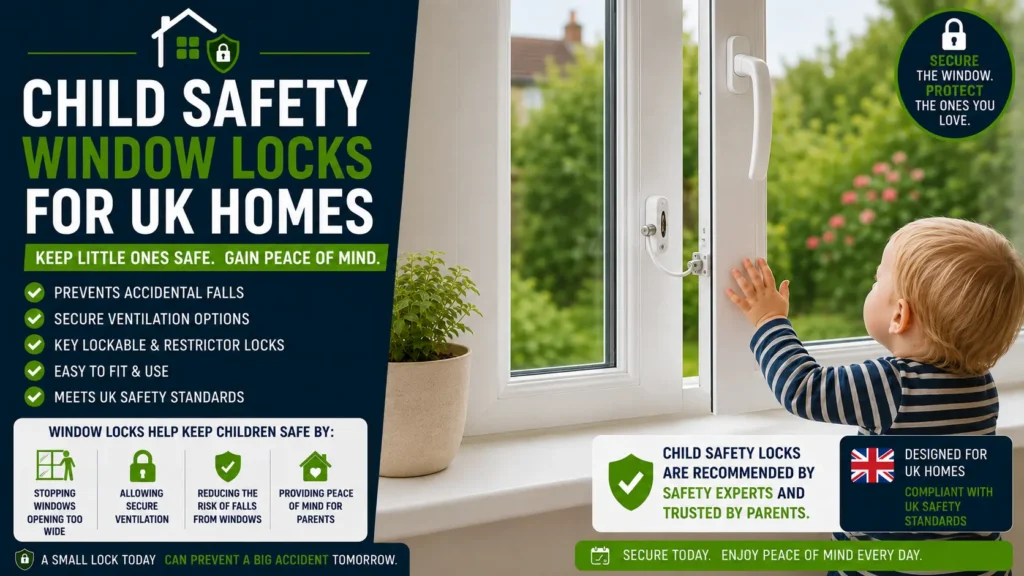
RoSPA recommends that all windows above ground floor level be fitted with a restrictor or lock that prevents the opening exceeding 100mm — wide enough for ventilation, not wide enough for a child to pass through. This 100mm figure is the industry benchmark, widely referenced in industry guidance including BS 8213-1 and UK home safety recommendations.
“Falls from windows are among the most preventable accidents in the home. Simple, low-cost restrictors save lives.”— RoSPA Home Safety Guidance · rospa.com
The sobering reality: most falls happen in under a second, in familiar rooms, when a parent is nearby. It’s not about negligence — it’s about the gap between a child’s curiosity and a window’s unguarded opening.
What UK law and standards require
Building Regulations
Under Part K of the UK Building Regulations, windows in new builds and significant renovations must incorporate protection against falls, particularly on upper floors. If you’re having new windows fitted — including replacement double glazing — your installer should be advising you on this automatically.
BS 8213-1
The governing standard for window hardware safety in the UK is BS 8213-1. Any child safety window restrictor or lock worth purchasing should carry compliance with this standard. It tests for load resistance, ease of adult operation in emergencies, and durability under repeated use. When you’re browsing products, this certification is non-negotiable.
Secured by Design
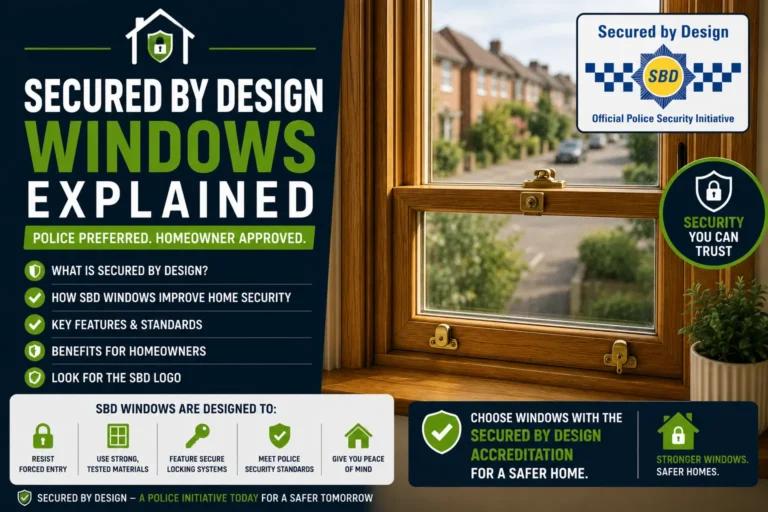
Secured by Design (SBD) is the official UK police initiative for crime prevention through design. Some window restrictors and locks are SBD-certified, meaning they’ve also been tested for resistance against forced entry — a dual benefit protecting both children and the property. If security is a concern alongside child safety, look for the SBD mark. Read more in our guide to Secured by Design windows explained.
Age-specific guidance: matching the lock to the child
Child safety isn’t one-size-fits-all. What works for a crawling toddler may be ineffective for a determined eight-year-old.
Age group
Toddlers (12 months – 3 years)
Children are mobile but lack the dexterity to operate complex mechanisms. Magnetic key locks and keyed restrictors are most appropriate — the adult-only release mechanism is genuinely toddler-proof. Keep cots and furniture away from windows entirely.
Age group
Pre-school to primary (3 – 8 years)
The highest-risk window. Children are strong enough to push windows and curious enough to lean out. Window restrictors with a maximum 100mm opening are essential, with a dual-action release beyond a child’s problem-solving at this stage.
Age group
Older children (8 – 14 years)
Older children can often defeat basic mechanisms. Keyed locks or high-mounted restrictors are more reliable. It’s also worth beginning direct conversations about window safety — children this age can understand and respond to reasons.
Specific product recommendations
All prices correct at time of writing. Products are widely available through major UK DIY retailers and directly from manufacturers.
Jackloc
Pro-5 Window Restrictor
£12 – £18
Steel cable system restricting opening to 100mm. Adjustable, compatible with most casement and timber windows, key-operated override for adults. Meets BS 8213-1 and aligned with RoSPA safety guidance. Ideal for families with children under 10.
ERA
Childproof Window Lock
£8 – £14
Concealed push-button mechanism for adult release. Suited to uPVC casement windows — the most common window type in UK homes. Good balance of price and reliability. BS 8213-1 compliant.
Yale
P-WL1-CH Window Lock
£10 – £16
Dual-action release operable one-handed in an emergency. Fits most standard uPVC and timber frames. Available in Secured by Design-compatible variants. See our tilt-turn window guide for European frame compatibility.
For a typical three-bedroom home, budget £50–£80 to cover all upper-floor windows at £5–£25 per lock.
Emergency egress: the fire escape requirement
This is where many well-meaning parents make a critical mistake: they lock windows so securely that in a fire, nobody can get out.
Fire safety requirements — GOV.UK fire safety guidance
- Clear opening of at least 0.33m² in area
- Opening height or width of at least 450mm
- Window must be openable from the inside without the need for a removable key, or with a key that is immediately accessible — stored visibly beside the window itself, not in another room
- At least one qualifying window per bedroom on upper floors
The solution is a dual-release restrictor — a lock that holds the window to 100mm in normal use but can be quickly released by pressing a button, pulling a cord, or using a key kept immediately beside the window. Products like the Jackloc Pro-5 and ERA childproof range are designed with exactly this dual function.
Never fit a lock that requires a key stored downstairs or in another room. In a fire, seconds matter.
Installation: DIY guidance and video resources
Most window restrictors are genuinely DIY-friendly — two screws, a drill, and ten minutes per window. That said, installation quality directly affects safety performance.
Installation video guidance
Before installing, watch the manufacturer’s official installation video. Jackloc, ERA, and Yale all have tutorials on YouTube that walk through the process for specific window types. Search “[brand name] window restrictor installation” on YouTube. These videos show correct anchor placement, screw depth, and how to test that the restriction is holding correctly — details that aren’t always clear from printed instructions.
Key installation rules
- Always drill into the window frame, not just the bead or trim
- Use the fixings supplied — aftermarket screws can fail under load
- Test by applying firm pressure toward the open position after fitting
- Install out of children’s direct reach where possible — high on the frame, not at the mid-rail
- For complex window types, use a FENSA-registered installer to protect your window’s warranty
Additional safety measures around windows
Window locks are the foundation, but a layered approach is more effective:
- Window guards and grilles: Fixed bars or mesh that block the opening entirely. Suitable for rooms that don’t double as fire escapes. Strong materials only — avoid thin aluminium that can be pushed out.
- Furniture placement: Beds, chairs, and bookcases near windows are climbing aids. Rearranging a bedroom can reduce risk as much as any lock.
- Window screens: Bug screens provide a false sense of security — they will not stop a child. Don’t rely on them.
- Conversation: For children over five, talking directly and honestly about why windows are restricted is a genuine safety measure. Children who understand a rule comply with it better than those who don’t.
Common mistakes to avoid
- Buying locks that don’t fit your window type — always check uPVC vs timber vs aluminium compatibility before purchasing
- Skipping the emergency egress check — fit dual-release restrictors on all upper-floor bedroom windows without exception
- Forgetting to inspect regularly — check locks every three months and replace immediately if any component shows wear
- Relying on furniture rearrangement alone — it helps, but locks are the primary defence
References and further reading
- RoSPA — Child home safety guidance
- GOV.UK — Building Regulations approval (Part K)
- GOV.UK — Fire safety guidance for premises with sleeping accommodation
- Secured by Design — Police-approved security standards
- FENSA — Registered window installer certification
- BS 8213-1 — Windows, doors and rooflights: design for safety in use and during cleaning
Child safety window locks protect young children from one of the most preventable accidents in the UK home. RoSPA’s data makes the stakes clear, but the solution is available at any DIY shop for under £20 per window.
Choose BS 8213-1 compliant products from trusted brands — Jackloc, ERA, or Yale — fit them correctly with emergency egress in mind, and check them regularly.
If your windows don’t currently have restrictors fitted, this is one of the fastest and lowest-cost safety upgrades you can make to your home — most installations take under 15 minutes and cost less than a takeaway.