Imagine stepping into your conservatory on a scorching July afternoon and feeling genuinely comfortable, no sticky heat, no blinding glare. Then picture the same space in January, cosy and warm, without your energy bills going through the roof.
For millions of UK homeowners, this remains a fantasy. A conservatory that bakes in summer and freezes in winter isn’t just uncomfortable, it’s wasted space and wasted money. But the technology to fix this exists right now, and the investment case has never been stronger.
This guide covers everything you need to know: the latest glazing technologies, U-value benchmarks, Building Regulations requirements, real costs, and the ROI data that makes upgrading a smart financial decision, not just a comfort one.
🏠 Quick Answer
Can a conservatory be comfortable all year round? Yes with modern Low-E or solar control glazing, an insulated roof, and proper sealing, a conservatory can maintain stable temperatures in both summer and winter. Most upgrades target U-values of 1.4 W/m²K or lower to meet current UK standards. The layered approach combining high-performance glass, roof insulation, draught-proofing, and supplementary heating or cooling turns an underused space into a genuine year-round room.
Best Solution by Problem
Not sure where to start? Use this as your quick reference:
| Problem | Best Fix |
|---|---|
| Too hot in summer | Solar control glass, roof blinds, ventilation |
| Too cold in winter | Low-E argon double glazing, insulated roof |
| High glare | Solar control glass or automated blinds |
| Condensation | Better ventilation, warm-edge spacers, improved seals |
| High energy bills | Insulated roof + high-performance glazing |
Why Traditional Conservatories Fail: The Physics of the Problem
Before exploring solutions, it helps to understand why conservatories are so thermally challenging in the first place.
A typical older conservatory is essentially a glass box. Single-glazed units have a U-value of around 5.8 W/m²K, meaning they allow nearly six watts of heat to pass through every square metre for every degree of temperature difference between inside and out. In a UK winter, that’s catastrophic heat loss. In summer, the same glass transmits solar gain freely, turning the space into an oven.
The Glass and Glazing Federation (GGF) estimates that glazing can account for up to 60% of total heat loss in conservatories, making it the single most impactful area for improvement. Poor insulation compounds the problem: gaps, draughts, and uninsulated roofs mean that even when you run heating, warmth escapes almost immediately.
The result? Anecdotally, many UK conservatories are used for only a fraction of the year compared to 365 days for the rest of the house. For many homeowners, that means thousands of pounds spent on a space that is rarely usable.
Modern Glazing Technologies: U-Values, Coatings and Smart Glass
U-Value Comparison: What the Numbers Actually Mean
U-values measure how quickly heat passes through a material. The lower the number, the better the insulation. Here’s how glazing options compare:
| Glazing Type | Typical U-Value (W/m²K) | Notes |
|---|---|---|
| Single glazing | 5.6 – 5.8 | Found in most pre-2000 conservatories |
| Standard double glazing | 2.8 – 3.0 | Minimum acceptable; outdated by modern standards |
| Low-E double glazing | 1.4 – 1.8 | UK Building Regulations compliant |
| Argon-filled double glazing | 1.2 – 1.6 | Gas fill improves insulation performance |
| Triple glazing | 0.6 – 1.0 | Highest performing; Passivhaus standard |
The Energy Saving Trust advises that upgrading from single to A-rated double glazing in a typical semi-detached home can save between £95 and £115 per year on energy bills, and conservatories, with their larger glass surface area, often yield even greater savings per upgrade.
Low-E Glass: The Workhorse of Thermal Performance
Low-emissivity (Low-E) glass features a microscopically thin metallic oxide coating invisible to the eye that dramatically reduces heat transfer. In winter, it reflects radiant heat back into the room rather than allowing it to escape. In summer, it reflects a portion of incoming solar radiation before it can warm the interior.
For conservatories, soft-coat Low-E glass (applied in a vacuum during manufacturing) offers the best thermal performance, with U-values as low as 1.0 W/m²K when combined with argon fill in a double-glazed unit. FENSA-registered installers are required to self-certify that replacement glazing meets Building Regulations thermal performance standards meaning Low-E glass in argon-filled units is now the baseline expectation for compliant work.
Solar Control Glass: Managing Summer Heat Gain
Solar control glass addresses the summer overheating problem through a different mechanism. Rather than focusing primarily on insulation, it uses a specialist coating typically containing silver or titanium to reflect a significant proportion of solar energy before it enters the building.
Key performance metrics include:
- Total Solar Energy Transmittance (g-value or SHGC): A lower g-value means less solar heat enters the room. Standard glass has a g-value of around 0.85; good solar control glass achieves 0.25–0.40, blocking 60–75% of solar heat gain.
- Light Transmittance: Quality solar control glass maintains 60–70% visible light transmittance, so the room stays bright even as heat is rejected.
- UV Protection: Most solar control coatings block 99% of UV radiation, protecting furniture and flooring from fading.
Products such as Pilkington Activ Solar, Saint-Gobain Cool-Lite, and Guardian SunGuard are widely available through UK glazing suppliers and represent a substantial upgrade over standard Low-E for south-facing conservatories.
Triple Glazing: The Premium Option
Triple-glazed units add a third pane and a second gas-filled cavity, pushing U-values down to 0.6–0.8 W/m²K in the best performing products. The GGF notes that triple glazing also delivers a 30–40% reduction in noise transmission compared to standard double glazing a significant benefit if your conservatory faces a road or garden with ambient noise.
The trade-off is weight and cost. Triple-glazed roof panels in particular require robust structural support, so a full structural survey is advisable before specifying them for an existing conservatory frame.
Active / Switchable Glass
Electrochromic and thermochromic “smart glass” represents the frontier of conservatory glazing. These products can tint on demand either automatically in response to heat or light sensors, or manually via a switch or smartphone app. Industry observers suggest that a growing proportion of high-end UK conservatory installations now incorporate some form of smart climate control, including active glazing, automated blind systems, or integrated HVAC management.
The technology remains premium-priced, expect to pay £150–£300 per m² for switchable glazing panels, but costs have fallen significantly in recent years as demand has grown.
Building Regulations for Conservatory Glazing
This is an area many homeowners overlook but getting it wrong can create problems when you sell.
Under GOV.UK Building Regulations, conservatories are generally exempt from full Building Regulations compliance provided they meet specific criteria: they must be at ground level, separated from the main house by an external-quality door or wall, have their own independent heating (not connected to the main system), and be less than 30m² in floor area.
However, the glazing itself must still comply with Part L (Conservation of Fuel and Power) and Part K (Protection from Falling). This means:
- All glazing in a conservatory must have a minimum U-value of 1.6 W/m²K (or lower) for replacement units
- Roof glazing must carry appropriate safety ratings
- Where the exemption criteria are not met, full Building Regulations approval is required, including compliance with current thermal standards
The Planning Portal provides detailed guidance on permitted development rights for conservatories. If your conservatory was built without the separation requirements or is connected to the main home’s heating system, a retrospective application may be needed.
VAT note: Since April 2022, the installation of qualifying energy-saving materials, including certain glazing upgrades, may attract 0% VAT in Great Britain. HMRC guidance sets out the specific criteria; professionally installed Low-E glass, solar control glass, and insulation products may qualify, but eligibility depends on the product specification and how the installation is classified. Always confirm VAT treatment with your installer before accepting a quote.
FENSA-registered or Certass-registered installers can self-certify their work as Building Regulations compliant, removing the need for a separate local authority inspection. Always insist on a FENSA or Certass certificate from your installer.
Underfloor Heating Integration: The Invisible Comfort Layer
Underfloor heating (UFH) is increasingly popular in conservatory renovations, and for good reason. Unlike radiators, which heat air unevenly and create cold spots near glass, UFH delivers radiant heat from the floor up, warming the entire thermal mass of the room evenly.
Electric UFH is the most practical option for most conservatories. Mat systems can be installed beneath tiles, stone, or engineered wood flooring at a typical cost of £50–£80 per m² (supply and fit). A 15m² conservatory floor would therefore cost £750–£1,200 to fit with electric UFH, a modest cost relative to the comfort improvement.
Wet (hydronic) UFH linked to your central heating boiler offers lower running costs but requires more invasive installation. It works best when planned as part of a larger renovation rather than a retrofit.
Smart thermostats such as Hive, Nest, or Drayton Wiser can control conservatory UFH independently, ensuring the room reaches your preferred temperature before you use it and switches off automatically. Running costs for a well-insulated 15m² conservatory are typically £100–£180 per year with electric UFH manageable when viewed alongside the energy savings from improved glazing.
Cost of Key Solutions: What to Budget in 2026
Transparent pricing helps homeowners plan with confidence. The following figures reflect current UK market rates including labour, with VAT depending on eligibility:
| Upgrade | Typical Cost Range | Notes |
|---|---|---|
| Low-E double glazing replacement (roof + walls) | £3,500 – £8,000 | Depends on size and frame material |
| Triple glazing upgrade | £6,000 – £14,000 | Includes thermostat, sensors, and glazing integration |
| Full conservatory roof replacement | £4,500 – £12,000 | Solid or tiled roof with insulated panels |
| Solar control glass specification | £800 – £2,500 additional | Over standard Low-E pricing |
| Automated roof blinds (full system) | £1,500 – £4,000 | Motorised, with remote or app control |
| Electric underfloor heating (15m²) | £750 – £1,200 | Supply and fit |
| Smart climate control system | £1,200 – £3,500 | Includes thermostat, sensors, glazing integration |
Which? recommends obtaining at least three quotes from FENSA or Certass-registered installers and checking reviews via TrustATrader or Checkatrade before committing.
💬 Want an accurate price for your conservatory upgrade? Costs vary widely depending on size, glazing specification, and installer. The fastest way to know what your project should realistically cost is to compare quotes from verified UK installers who work to FENSA or Certass standards.
👉 Get free conservatory upgrade quotes at doubleglazingquote.net
The ROI Case: Why This Investment Makes Financial Sense
Beyond comfort and energy bills, conservatory upgrades have a compelling property value argument.
According to data referenced in the 2025 UK Houzz Home Report via KBB Focus, a well-designed and properly insulated conservatory can deliver up to 100% ROI when the property is sold meaning the upgrade cost is fully recouped in added value. This figure applies specifically to conservatories that function as genuine year-round living spaces, with thermal performance comparable to the main house.
The financial logic stacks up from multiple angles:
- Energy savings: Upgrading a poorly performing conservatory to modern glazing standards can meaningfully reduce associated heating costs each year for an average-sized space, with the exact savings depending on the existing glazing, insulation standard, and how often the room is used
- Increased usable floorspace: A room used 365 days a year rather than 82 has a dramatically higher functional value equivalent to adding a usable room without extending the building
- Property saleability: Estate agents consistently report that buyers discount properties with visibly poor-quality conservatories; conversely, a sleek, thermally efficient conservatory is a positive selling point
- 0% VAT: The April 2022 change means qualifying energy-efficiency installations no longer attract 20% VAT, effectively reducing costs by a sixth versus the pre-2022 position
More broadly, energy efficiency is an increasingly prominent factor in property valuations, and a conservatory that functions as a genuine year-round room is likely to be viewed more favourably by buyers and surveyors than one that clearly overheats in summer or requires constant additional heating in winter.
When to Replace the Roof Instead of Just Re-Glazing
Many homeowners assume re-glazing the walls is sufficient. In some cases, it is. But if your conservatory roof is polycarbonate or single-skin glass, replacing just the wall panels will deliver limited results because the roof remains the dominant source of heat gain in summer and heat loss in winter.
Consider a full roof replacement rather than re-glazing alone if any of the following apply:
The roof is polycarbonate. Polycarbonate panels degrade over time, yellowing and losing insulating performance. Even new polycarbonate cannot match the thermal performance of a modern glass or solid tiled roof system. Re-glazing the walls of a polycarbonate-roofed conservatory will not solve the temperature problem.
The conservatory overheats severely in summer. If temperatures regularly become unbearable on sunny days regardless of blinds or ventilation, the roof is almost certainly the primary cause. Solar control glass in the walls will help at the margins, but a solid insulated roof with a U-value of 0.18 W/m²K or better is a more decisive fix.
You want to use the room through winter without supplementary heating. A glass roof, even double-glazed, loses heat far faster than an insulated solid roof. If year-round comfort without a dedicated heater is the goal, a roof replacement is the most reliable route.
The roof structure shows signs of wear, leaks, or failed seals. If you are already facing repair costs on an ageing roof, the incremental cost of a full replacement rather than a repair is often modest, and the thermal upgrade is substantial.
Roof replacement typically costs £4,500 to £12,000, depending on size, roof type, and finish. The most popular options are tiled solid roofs with insulated rafters (the warmest, most house-like result) and thermally broken glass roofs using modern low-U-value units. For a detailed breakdown of options and costs, see our full guide: Replacing Your Conservatory Roof for Maximum Thermal Performance and Value.
Putting It All Together: A Layered Approach to Year-Round Comfort
No single technology solves the conservatory temperature problem in isolation. The most comfortable, energy-efficient conservatories combine several layers:
- High-performance glazing (Low-E, argon-filled double or triple) as the thermal envelope foundation, targeting a whole-unit U-value of 1.4 or below
- Solar control coating on south- or west-facing elevations to manage summer heat gain without sacrificing light
- Insulated roof replacement: the roof is typically the weakest point and the highest-impact upgrade; explore your options here
- Draught-proofing and sealing around all frames, thresholds, and roof junctions
- Underfloor heating for even, efficient winter warmth
- Automated blinds or smart glass for dynamic solar management on the hottest days
- Ventilation, automatic roof vents, or a heat recovery ventilation (HRV) unit to maintain fresh air without temperature loss
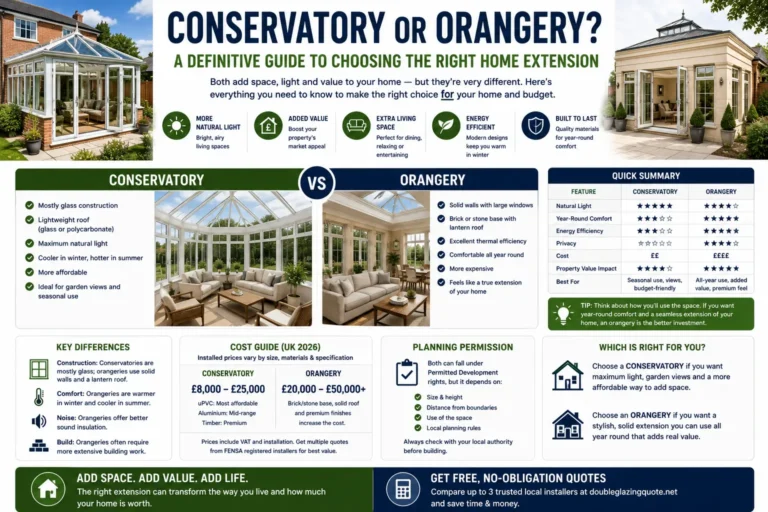
If you’re deciding between a conservatory and a full orangery build with its higher specification and greater structural permanence, our comprehensive comparison guide walks through the differences in detail.
Frequently Asked Questions
Is it better to replace the conservatory glass or the roof? If your roof is polycarbonate, leaking, badly insulated, or causing severe summer overheating, roof replacement usually gives the biggest comfort improvement. If the roof is already modern and well-sealed, upgrading the wall glazing may be enough.
What glazing U-value do I need to meet UK Building Regulations? Replacement glazing in conservatories must achieve a minimum centre-pane U-value of 1.6 W/m²K under Part L of the Building Regulations, though most reputable installers now specify significantly better than this as standard.
Is planning permission needed to upgrade conservatory glazing? Generally, no replacement like-for-like glazing is permitted. However, changing the structure or footprint of the conservatory may require planning permission. Check the Planning Portal or consult your local authority.
Does 0% VAT apply to my glazing upgrade? If the installation is carried out by a VAT-registered contractor and meets the qualifying criteria under HMRC guidance, 0% VAT applies. Ask your installer to confirm eligibility before accepting a quote.
How long does a glazing upgrade take? A full conservatory re-glaze replacing both roof panels and wall units typically takes 2–4 days, depending on size and specification.
The breakdown
The all-year-round conservatory is not a luxury; it’s the expected outcome of specifying the right glazing, insulation, and climate systems from the outset, or upgrading an older space to modern standards. With U-values down to 0.6 W/m²K for triple glazing, VAT relief potentially available on qualifying installations, potential ROI of 100% at resale, and potential energy savings over time, the case for upgrading has never been more financially straightforward.
Start with a FENSA or Certass-registered surveyor, specify Low-E solar control glass as a minimum, and build outward from there based on your orientation, usage patterns, and budget. Your conservatory should be the room you want to spend time in, not the one you avoid for nine months of the year.
Sources: Energy Saving Trust | GOV.UK Building Regulations | HMRC VAT on Energy-Saving Materials | FENSA | Glass and Glazing Federation | Certass | Which? | Planning Portal | KBB Focus / 2025 UK Houzz Home Report